Tuesday, 13 October 2026

How startups must adapt their business models to overcome the scepticism of conservative contractors.
How startups must adapt their business models to overcome the scepticism of conservative contractors.
 Priya Dialani
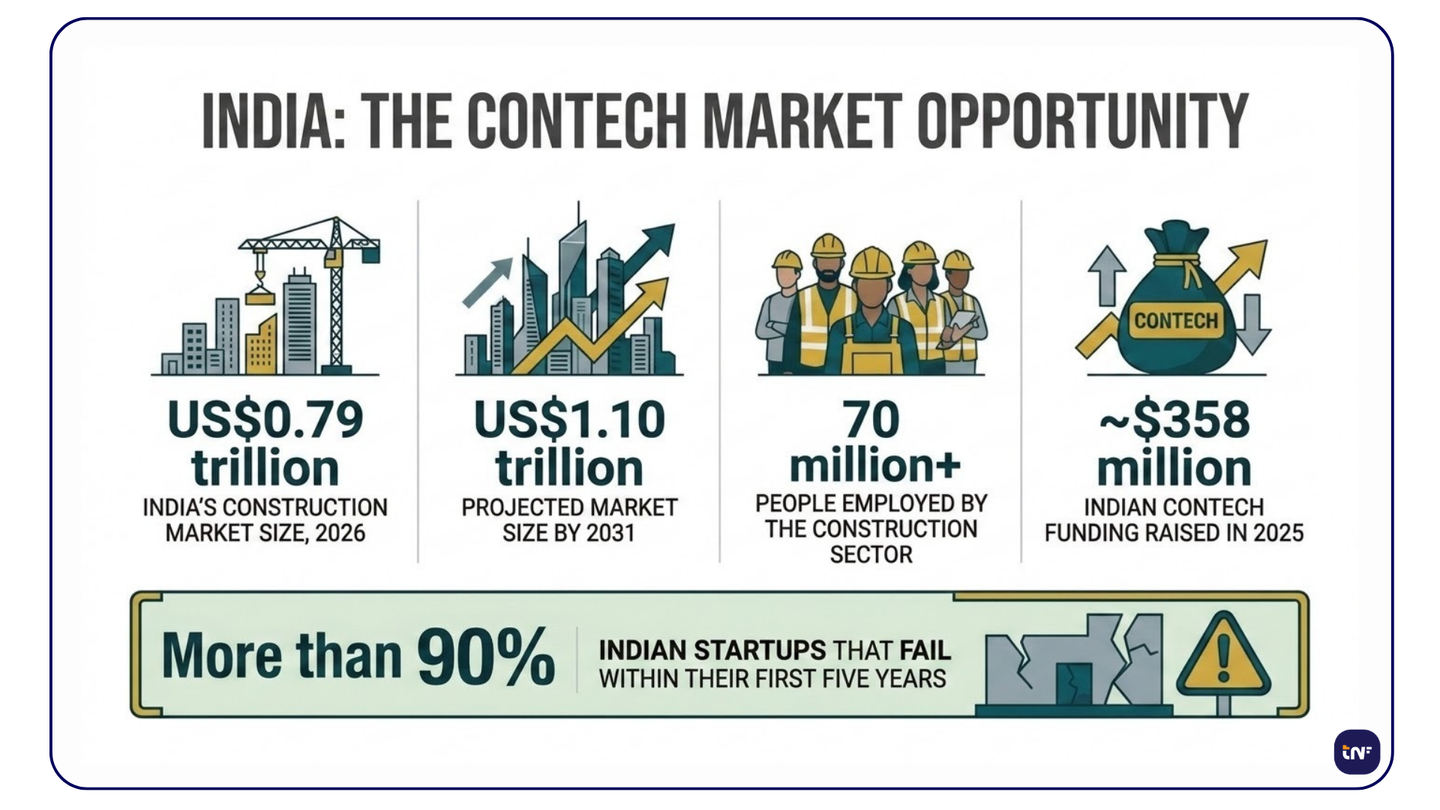
India's construction ecosystem, one of the world's largest, has long depended on rule-of-thumb estimation and experience. Today, in the AI era, the sector is expanding at a pace that even outstrips India's robust economic growth. With the market , according to Mordor Intelligence, the opportunity in construction technology (contech) is significant. But it will only reward those willing to confront the industry's entrenched challenges head-on. Those who disregard the industry's fundamental complexities, its fragmented supply chains, long procurement cycles, and deep relational trust networks, inevitably fail.







According to a 2017 study by the IBM Institute for Business Value and Oxford Economics, approximately 90% of Indian startups fail within their first five years. While founders are busy rolling out pilot after pilot, contractors are still struggling to assess the return on investment of a solution. That's when frustration can set in.
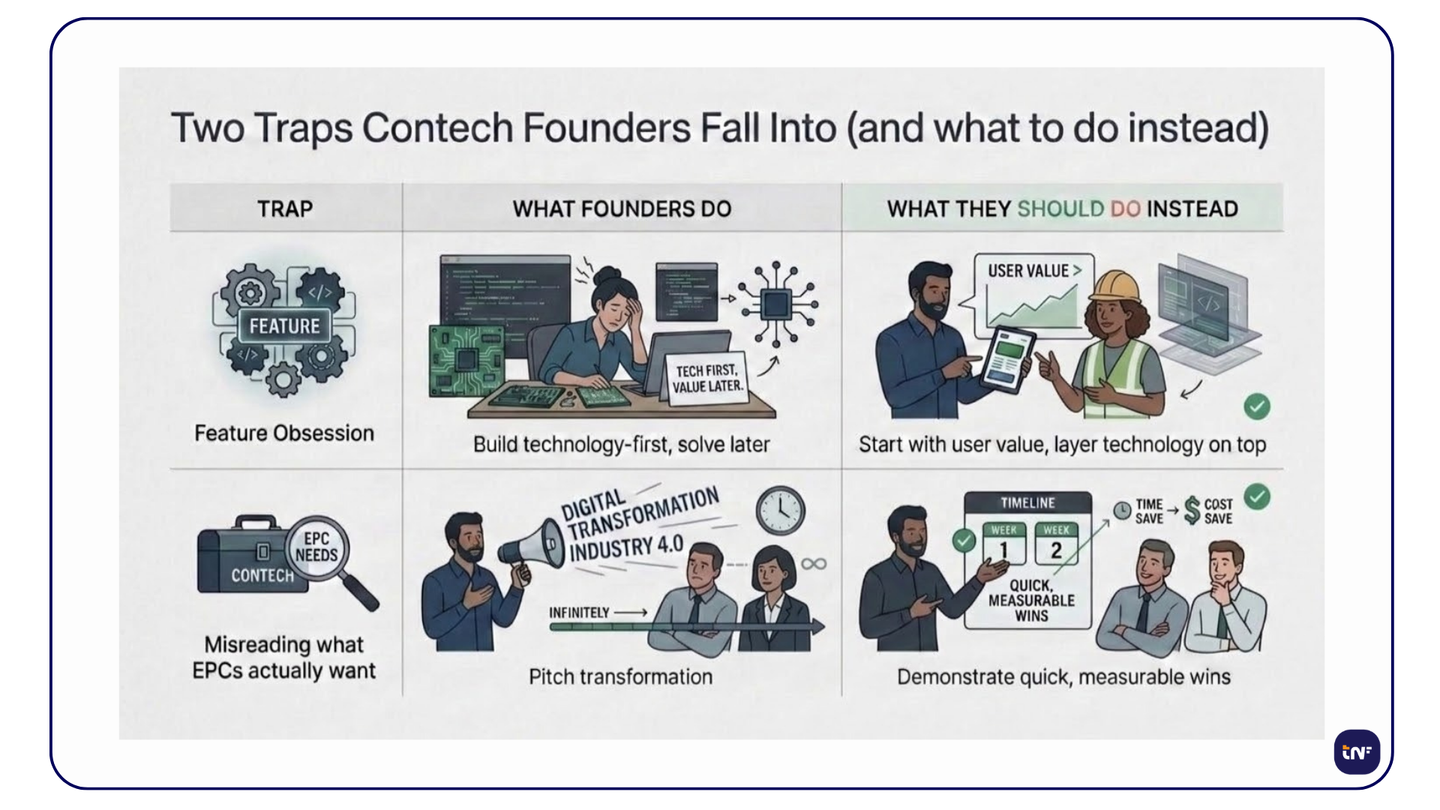
Many contech startup founders come from deep industry backgrounds, having experienced operational challenges firsthand. So, they set out to build products to solve the problems they once faced themselves. However, instead of driving high-value innovation, the focus shifts overwhelmingly toward the technology rather than the user. While founders have a true obsession of fixing the complexities of the industry, they frequently overlook real-value propositions and end up creating mere flashy cool products.
Souces:
Mordor Intelligence, International Labour Organization, IBM Institute for Business Value and Oxford Economics, Tracxn — Construction Tech India Feed.
First, maintain a balanced focus on product and customer. Innovate solutions that are value-driven and not feature-driven.
John Mackey and Raj Sisodia in their book Conscious Capitalism rightly argue that instead of focusing on making money, companies should become agents of a broader ecosystem and create value for all stakeholders: customers, employees, suppliers, investors, and society. This is highly applicable for contech founders; solving industry complexity must go hand in hand with delivering measurable user value. Founders should create agile solutions that they can test and pivot quickly responding to market views and continuously optimise the product-market fit.
Finally, the construction industry is structured around clear deliverables and tangible results; creating only SaaS solutions doesn't guarantee best outcomes. Tech founders should explore other models and choose a relevant one that incorporates user realities, allowing them a basis to compound on.

The Indian construction industry has long lagged in the adoption of technology. One of the key reasons lies in the broader market mindset, which is characterised by a "money-saving" attitude. Software-driven tech solutions are focused on time-saving and productivity gains, not designed solely to reduce costs. Additionally, small and medium-sized businesses (SMBs) in India continue to demand quick fixes instead of comprehensive, system-level solutions. At the same time, EPCs are reluctant to change current infrastructure, systems, and processes, making large-scale transformation difficult.
First, EPCs demand faster time-to-value. Create a product that delivers quick wins. Measurable impact builds trust far more effectively than long-term promises of transformation.
Second, if it is a SaaS offering, they should sell it as a solution that addresses the inefficiencies of the EPC project management lifecycle rather than a standalone software.
A strong example is Infra.Market, one of India's leading contech unicorns, now operating a multi-brand, multi-channel platform that has reshaped the construction materials supply chain. It addresses supply chain fragmentation by connecting manufacturers, distributors, and project owners across a unified digital platform.
Ultimately, treat technology as a means to an end and not the end itself.Sripad Nandiraj, Founder and CEO of WeHouse
Founders should move towards offering 'Outcome-as-a-service' solutions that meet current demands, can be integrated into existing workflows, and deliver tangible outcomes.
Launching WeHouse in 2017 was no small feat. The industry was deeply traditional, and the idea of integrating technology into home construction was met with scepticism. "The biggest challenge was establishing trust," Sripad Nandiraj, Founder and CEO of WeHouse shares. Initial attempts to raise funds from investors were met with hesitation, so he turned to consumers themselves, treating them as partners in the journey. "We treated them like investors, not just customers. Their support helped us build the initial tech and spread the word."

Contributing approximately 7.8 - 9% to the country's GDP, India's construction sector has become one of the three largest in the world, having reached that ranking by 2025 according to the Ministry of Housing and Urban Affairs. Shubhankar Bhattacharya, General Partner from Foundamental, a global VC firm, points out that the construction tech landscape has evolved enormously from a time when the term "construction tech" was barely recognised to India now being second close to the USA in terms of the number of contech Unicorns.
Out of 1.18K contech companies in India, 170 have gained funding, securing a total funding of more than $2.29B in the last 10 years. 2020 alone witnessed 122 contech startups in India, the highest in the last decade. As Bhattacharya points out, "India is not the easiest place to invest nor for foreign investments."
Interestingly, several of these startups are incubated at IIT Bombay, IIT Roorkee and IIT Delhi. As government-driven initiatives and investments continue to expand, these tech startups will attract more attention from global companies. The LeapFWD accelerator, jointly driven by India Accelerator (IA) and VS Fortune, supports early-stage proptech and contech ventures through funding access and structured innovation programmes.
Having said that, capital infusion is not enough. Investors are willing to invest in startups that have a broad vision, scalable revenue model, and most importantly, solutions that align with the end goals of the broader construction ecosystem.
Scaling technology in the field remains inherently challenging. You often come across different people on job sites, different projects demand different products, and field workers have difficulty adapting to digital tools.
Organisations should treat a startup as a strategic partner, beyond just a vendor. When contractors adopt this mindset, they're protecting and strengthening the ecosystem that eventually helps to innovate faster.
Another problem is misaligned expectations. Tech founders have preconceived notions of product success, while field workers and contractors struggle to understand what realistic implementation of the solution actually looks like in practice.
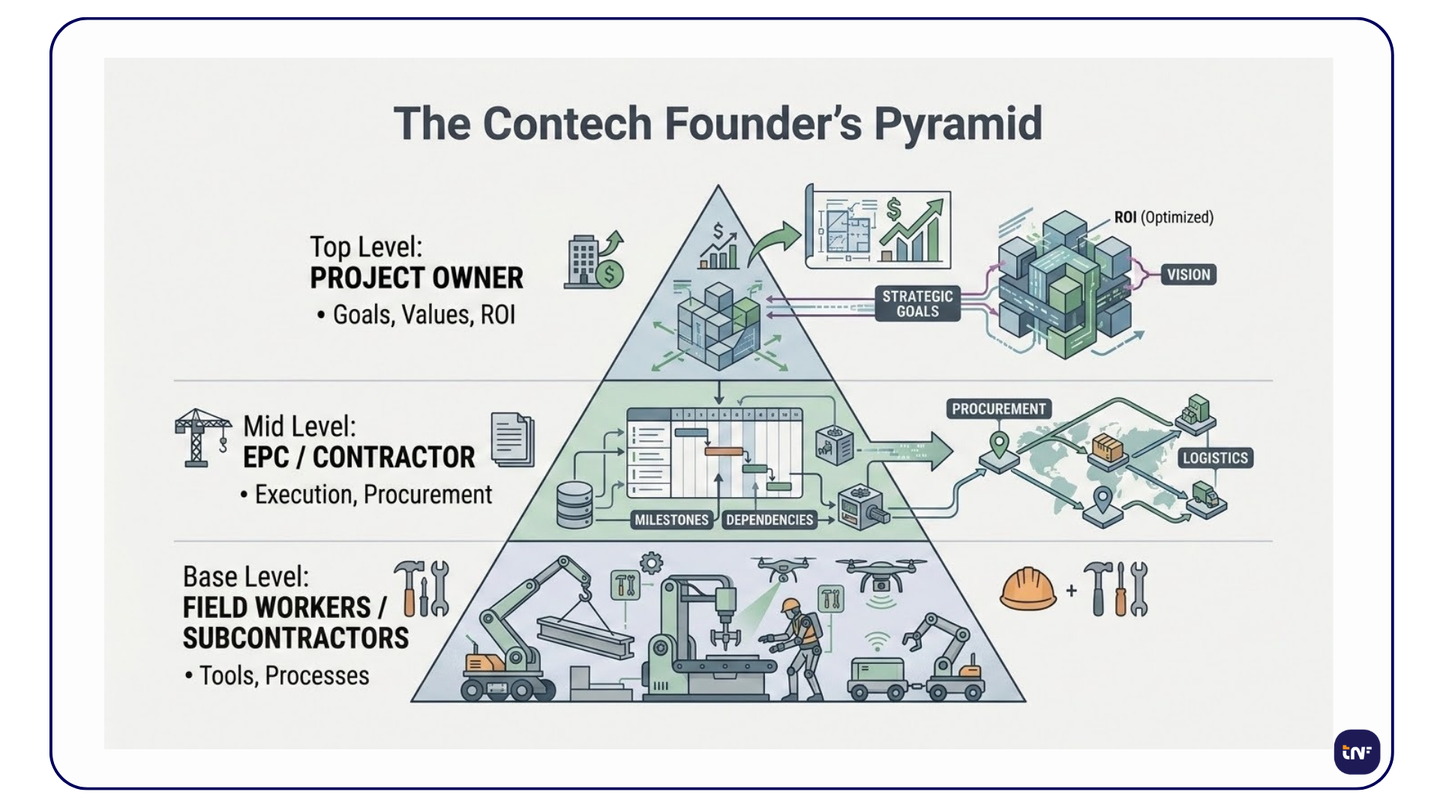
A lot of construction tech companies try to solve too many problems and lack focus on too low down the value chain. On the top of the pyramid of every project is the owner. If we don't address the goals and the values of the owner, then the further down the pyramid we go, the more fragmented the goals become; the harder it gets to innovate to scale technology in the field. Angelos Nicolaou, CEO at Sektor.build
The funding landscape of construction tech is great, government-led infrastructure initiatives and funding to support innovation-led entrepreneurship is growing, and tech adoption is steadily increasing. Taken together, these signals make one thing clear: construction technology holds immense untapped potential.
Startups that align with market realities, integrate into existing workflows, and deliver measurable outcomes are best positioned to become key players in this growth story. The industry does not reward clever technology. It rewards solutions that work within its constraints, deliver results that can be measured, and prove their value on the ground. Founders who build to that standard do not chase adoption. They earn it.
Disclaimer: Content provided by TNF India is for informational purposes only. While we aim to provide accurate data and strategic insights, information is subject to rapid market and technological shifts. This content should not replace independent due diligence or professional consultation. TNF India bears no responsibility for any actions taken, or financial losses incurred, in reliance on this material.
What an owner should receive at handover, and what actually arrives.