Tuesday, 13 October 2026
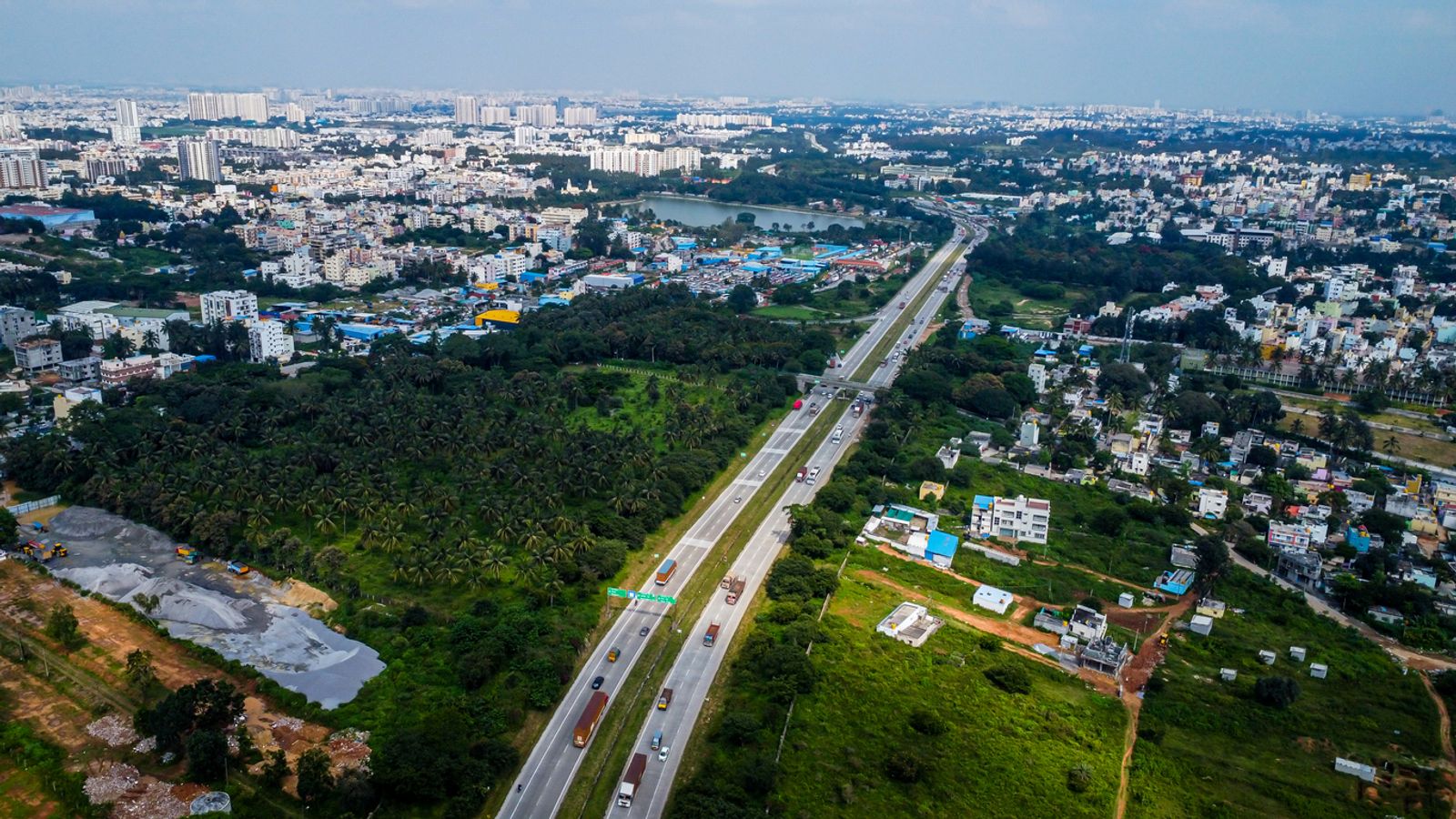
India's next property boom is happening along its expressways, not in its metros. How Bharatmala corridors are turning peripheral land into institutional-grade real estate.
India's next property boom is happening along its expressways, not in its metros. How Bharatmala corridors are turning peripheral land into institutional-grade real estate.
 Lalita Subrahmanyam
India’s next property boom will not happen in its metros, but the expressways connecting them.









India's real estate sector is on track to reach US$1 trillion by 2030, according to India Brand Equity Foundation. For a long time, the growth in this sector told only half the story. Economic activity, employment, and housing demand clustered in a handful of metropolitan centres, while regions with weak connectivity were starved of investment and left structurally underdeveloped.
That concentration is now being corrected. This is happening not incrementally, but by design. The Bharatmala Pariyojana programme is rebuilding the logic of how India moves. Six highway corridors are becoming fifty. The share of freight carried on highways is set to climb from 40% to between 70–80%. More than 550 districts will be connected by four-lane highways. Ring roads, bypasses, elevated corridors, and logistics parks are being added at scale with 34,800 km of new highways targeted by 2027–28.
The real estate implications follow directly. As highway corridors take shape, they are pulling economic activity, logistics infrastructure, and access-controlled expressways into previously bypassed geographies. Growth is no longer radiating outward from saturated metro; it is being routed along entirely new highway corridors.
Institutional capital has entered highway-adjacent micro-markets because the fundamentals justify it. End-user demand is real, yields are predictable, and volatility is low.
Highways today have evolved to become economic development platforms.

The Bharatmala project is redefining land valuations and helping to create megawarehousing clusters, logistics hubs and also encouraging affordable housing along its corridors. Tier 2 and tier 3 integrated townships developed along these corridors are attracting significant rental yields compared to suburban areas in highly developed metros. Each kilometre of these arterial corridors is translating connectivity into measurable land value appreciation while attracting spillover from urban agglomeration.

The clearest proof of what connectivity does to land values is Noida. Noida and Greater Noida suffered from stalled projects during 2013–16, while supply tightened further with the enforcement of the Real Estate Regulation and Development Act (RERA), which affected market credibility. As supply correction helped the market to gradually recover, it was reshaped by cautious developers who slowed new project launches. This caused demand to exceed supply and resulted in sharp price increases.
The road to Noida International Airport at Jewar turned into a multi-nodal economic anchor (cargo, MRO, hospitality, offices). This attracted InvITs, REIT-adjacent investors, and PE-backed developers, reducing perceived risk. Institutional participation raised capital valuations. According to ANAROCK Property Consultants, property values in the National Capital Region’s 14 key micro markets have risen between 24% and 139% between end-2021 and mid-2025. Sector-150 in Noida led with 139% capital value growth to ₹13,600/sq ft. Rentals in the same period increased up to 71%.
Connectivity upgrades and infrastructure investments are directly driving this price growth as metros, expressways, and airports receive upgrades, and commuting times shorten, and investors increasingly believe that infrastructure development is being prioritised.
A report from ANAROCK Property Consultants talks of how residential real estate prices near Dwarka Expressway, Gurugram, NCR grew by up to 80%.
The most powerful signal in India’s property market today is not demand, it is connectivity. Access corridors are thus turning into economic corridors, encouraging high freight, industrial nodes, and logistics hubs. Land use is transitioning from agriculture to commercial and residential development as low-income districts are connected to high-demand markets. The proposed expressways will not only reduce travel times and transport costs, but also close inequality gaps by impacting housing, office, retail, and industrial demands. Ancillary infrastructure needs also increase as agricultural and peri-urban land get converted to residential townships, logistics hubs, commercial nodes, and industrial parks.
The planned Ganga Expressway connects western Uttar Pradesh to the east, linking the state into national corridors for the first time. For cities like Meerut, Badaun and Shahjahanpur, that connection is likely to attach disconnected land to the market and reprice it accordingly.
The same repricing story played out along the Mumbai–Nagpur and Mumbai–Delhi expressways. They connected isolated markets to national networks, closed employment gaps, and gave capital a reason to arrive. As land values increase, the revenues of local bodies increase, enabling reinvestment into local infrastructure, reinforcing price cycles.

Micro-markets are organically taking shape at road junctions and rail-metro nodes. Employment anchors attract workforces. Workforces generate residential demand. Residential demand creates rental markets. The result is yield-backed growth that attracts long-term capital, not speculative interest.
These corridors connect producers with consumption markets even as they compress distances, enabling back-office relocation and manufacturing decentralisation. These micro-markets are absorbing demand that metros are unable to, meeting the need for extending urban spaces.
Expressways in NCR are a case in point, where the local economies are witnessing a multiplier effect, as burgeoning employment opportunities are bringing in developers with plans for integrated township development.
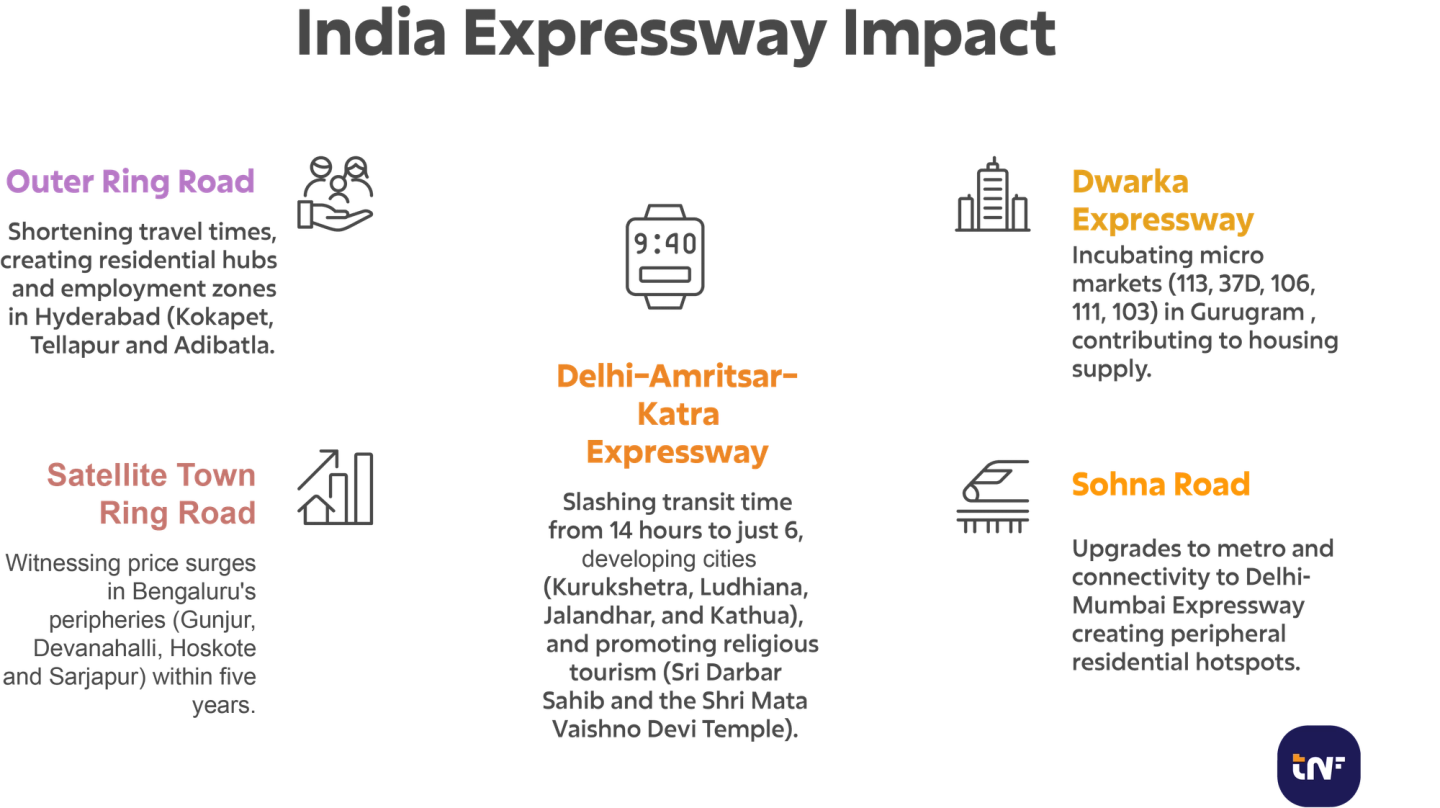
Tier-2 growth corridors like the Samruddhi Expressway near Nagpur are also boosting land prices driven by proximity to the expressway. There are several other examples:
A single logistics park can do what a decade of planning cannot. It can anchor employment, stabilise rents, and attract a neighbourhood. With the growth of e-commerce in India, demand for highway-adjacent fulfilment centres is high as they enable reliable deliveries on the same-day or next-day. Logistics parks are leased for long periods, offer predictable employment and a stable demand for housing reducing uncertainty and volatility.
35 Multi-Modal Logistics Parks (MMLPs), which integrate road, rail, and port connectivity, are at various stages of development under the Bharatmala Pariyojana. They are expected to help bring down the share of logistics in GDP and also eliminate the unpredictability in delivery times to improve reliability, and increase the availability of Grade-A warehousing spaces. These parks, in turn, are attracting investments and employment, raising the demand for warehouses, distribution centres, cold chains, and other facilities. Though capital-intensive by nature, these parks offer long-term value by fixing systemic inefficiencies and trigger secondary demand across commercial, residential, and social infrastructure. They catalyse overall growth and boost the price of lands around them.
Homebuyers are no longer choosing cities; they are choosing connectivity. The National Highway network in India grew from 91,287 km in 2014 to 146,560 km towards the end of 2025. This is a prime driver of development in highway peripheries with green spaces, better air quality and upcoming facilities. Enhanced connectivity and employment opportunities offered by highway peripheries are creating hotspots and micro-markets with high demand for residential properties that offer a better quality of life, shorter commuting times, with spacious homes in areas with lower population density in integrated townships.

Areas which are experiencing rapid growth as a result of this include the Dwarka and Yamuna Expressway in Delhi NCR, areas along the Mumbai-Nagpur Expressway, as well as Rajarhat, Joka and Madhyamgram in Kolkata, Hinjewadi in Pune, Devanahalli in Bengaluru and Kokapet in Hyderabad and many others. Access to employment, better amenities and lifestyle, educational institutions, healthcare facilities, retail and entertainment centres, planned townships, and affordability due to a lower price point than urban areas away from urbanisation pressures are all reasons why people are willing to make the shift. Remote/hybrid work is adding to this trend.
As highways emerge as the new organising framework for urban growth, real estate markets are re-pricing to reflect future income potential rather than past location disadvantages. In the strongest locations, highway corridors are commanding premium valuations. They are doing it by solving several problems at once: redistributing economic density, correcting decades of spatial mispricing, and absorbing urban growth that India's metros can no longer handle.
Disclaimer: Content provided by TNF India is for informational purposes only. While we aim to provide accurate data and strategic insights, information is subject to rapid market and technological shifts. This content should not replace independent due diligence or professional consultation. TNF India bears no responsibility for any actions taken, or financial losses incurred, in reliance on this material.
What an owner should receive at handover, and what actually arrives.