Tuesday, 13 October 2026
Grid shocks, stranded capital, and the load of India’s EV infrastructure surge.
Grid shocks, stranded capital, and the load of India’s EV infrastructure surge.
 Priya Dialani
In the Indian boardroom, execution invariably eats intent for breakfast. For India’s industrial and automotive leaders, the government’s extended PM E-DRIVE scheme looks, on paper, like an unmissable macroeconomic tailwind. A is funding a massive mandate: deploying 72,300 public charging stations by 2028. This infrastructure push serves as the anchor for India’s long-term transition toward Net Zero 2070.




But beneath the ambitious deployment headlines lies a stark operational reality that public subsidies alone cannot fix. As of mid-2026, nearly 18% of the country’s installed public charging infrastructure sits non-functional, a bottleneck confirmed by Ministry of Heavy Industries data tabled in Parliament showing that only 22,753 out of 27,737 installed stations are actually operational.
This leaves the ecosystem paralysed by legacy technology mismatches, equipment theft, and deep-seated disputes with state DISCOMs. For institutional investors and automotive OEMs, the metric that matters is no longer the number of plugs in the ground, but the revenue per charger and grid resilience.
The fundamental objective of the PM E-DRIVE scheme is to expedite the adoption of electric vehicles (EVs) across e-2Ws, e-3Ws, e-buses, e-ambulances and e-trucks, assemble robust charging infrastructure, and build a strong EV manufacturing ecosystem.
Initially rolled out as a two-year programme in 2024, the scheme has now been extended for two more years, till 2028. The scheme has ₹2,000 crore earmarked for electric vehicle public charging stations (EVPCS) across major cities, rural areas and highways to address range anxiety for long journeys.
The objective is to attain a 30% share of EVs in total vehicle sales by 2030. However, infrastructure and operational challenges that undermine the consistency and reliability of EV charging stations remain a challenge.
India is scaling its EV ecosystem at breakneck speed, but grid readiness remains a critical bottleneck.
The ultimate test of this transition will not be the number of charging plugs installed, but whether the underlying power grid is durable enough to handle the load.
Our power grids are designed for conventional residential loads with outdated transmission lines; EV charging consumes higher comparative power. Additionally, the country already faces demand spikes during evening peak hours. Charging an EV during such peak timings risks overloading the distribution networks, resulting in outages and voltage fluctuations.
The resulting overload inflicts a costly double blow: it dramatically reduces the operational lifespan of grid hardware while driving down overall energy efficiency. EVs with single-phase chargers often cause unbalanced current loading and phase voltages. This imbalance results in more power deprivation and violations of the system's voltage limits. Functioning on non-linear power, EVs inject harmonic currents into the grid distribution system, degrading power quality. The increasing number of EVs and rapid charging will inevitably increase harmonic distortions.
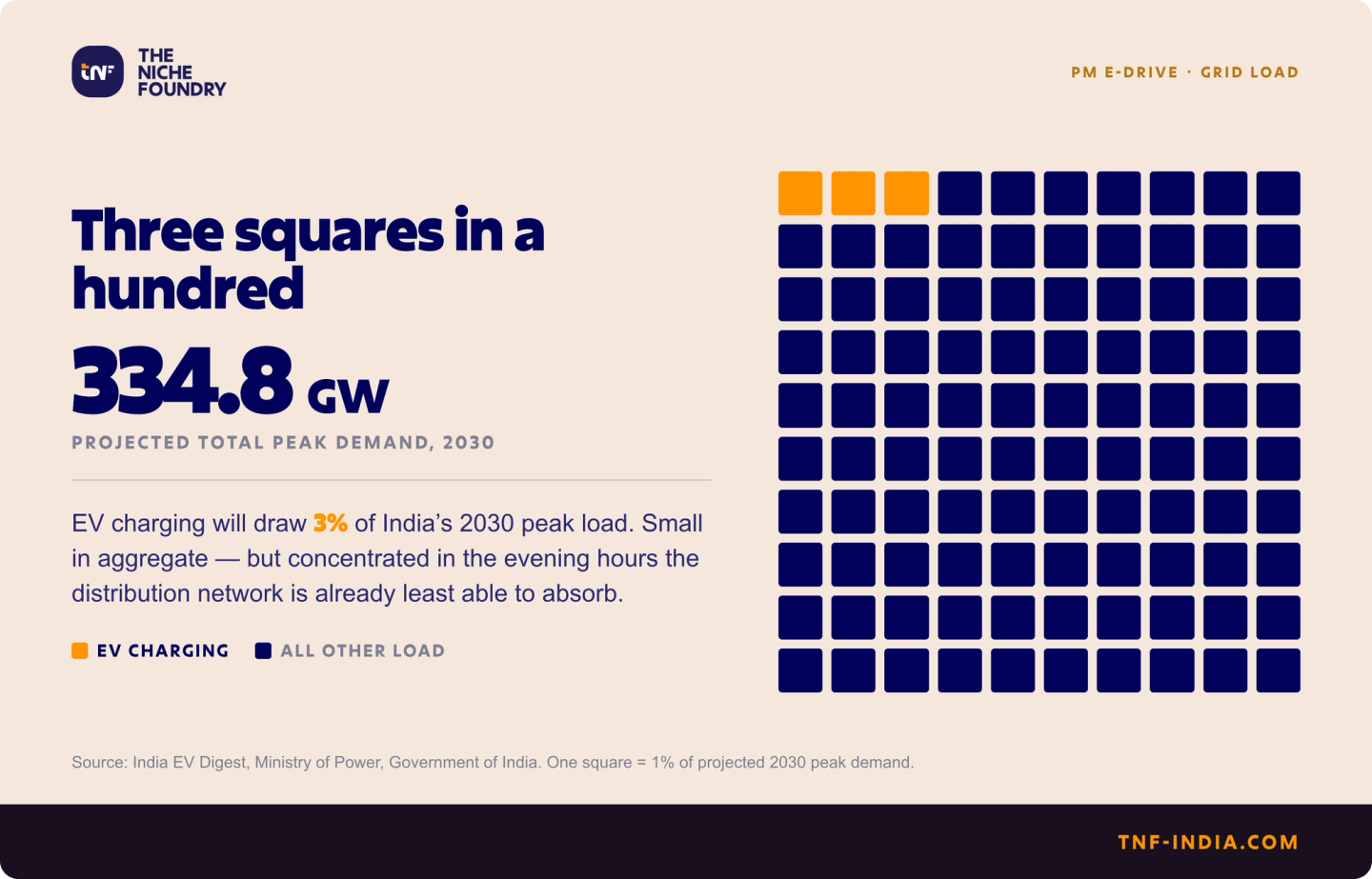
Source: India EV Digest, Ministry of Power, Government of India
The total peak demand in India is expected to be 334.8 GW by 2030 and EV charging demand will occupy 3% of the total peak demand. A recent Centre for Social and Economic Progress (CSEP) research underscores that EVs' contribution toward sustainability is lower as 75% of the power to electricity grids is derived from fossil fuels.
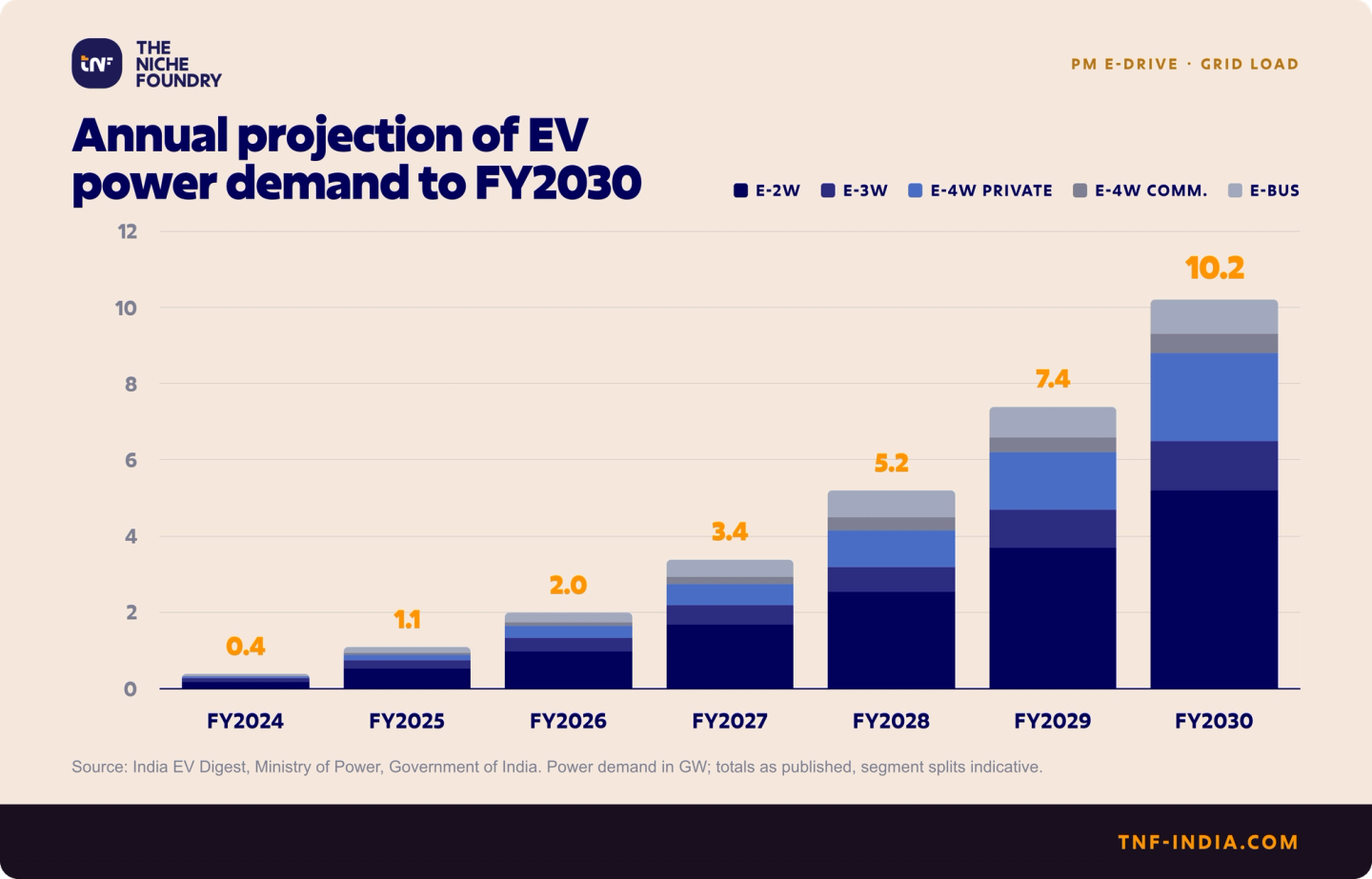
Source: India EV Digest, Ministry of Power, Government of India
According to the India EV Digest (Ministry of Power, March 2023), approximately 9 crore EVs are projected to be operational in India by 2030. Meeting this scale of EV deployment will require a charging network of at least 13 lakh public stations by 2030, according to Observer Research Foundation (ORF) projections. This is against a government installation target of 1 lakh, a structural infrastructure gap that no subsidy scheme alone can close. As of March 2026, roughly 22,753 public EV charging stations are operational nationwide out of 27,737 installed, leaving an 18 per cent non-functional rate that undermines the deployment headline. The urgency extends far beyond deployment numbers: every station installed must be reliable, affordable, and safe, criteria the current rollout is consistently failing to meet.
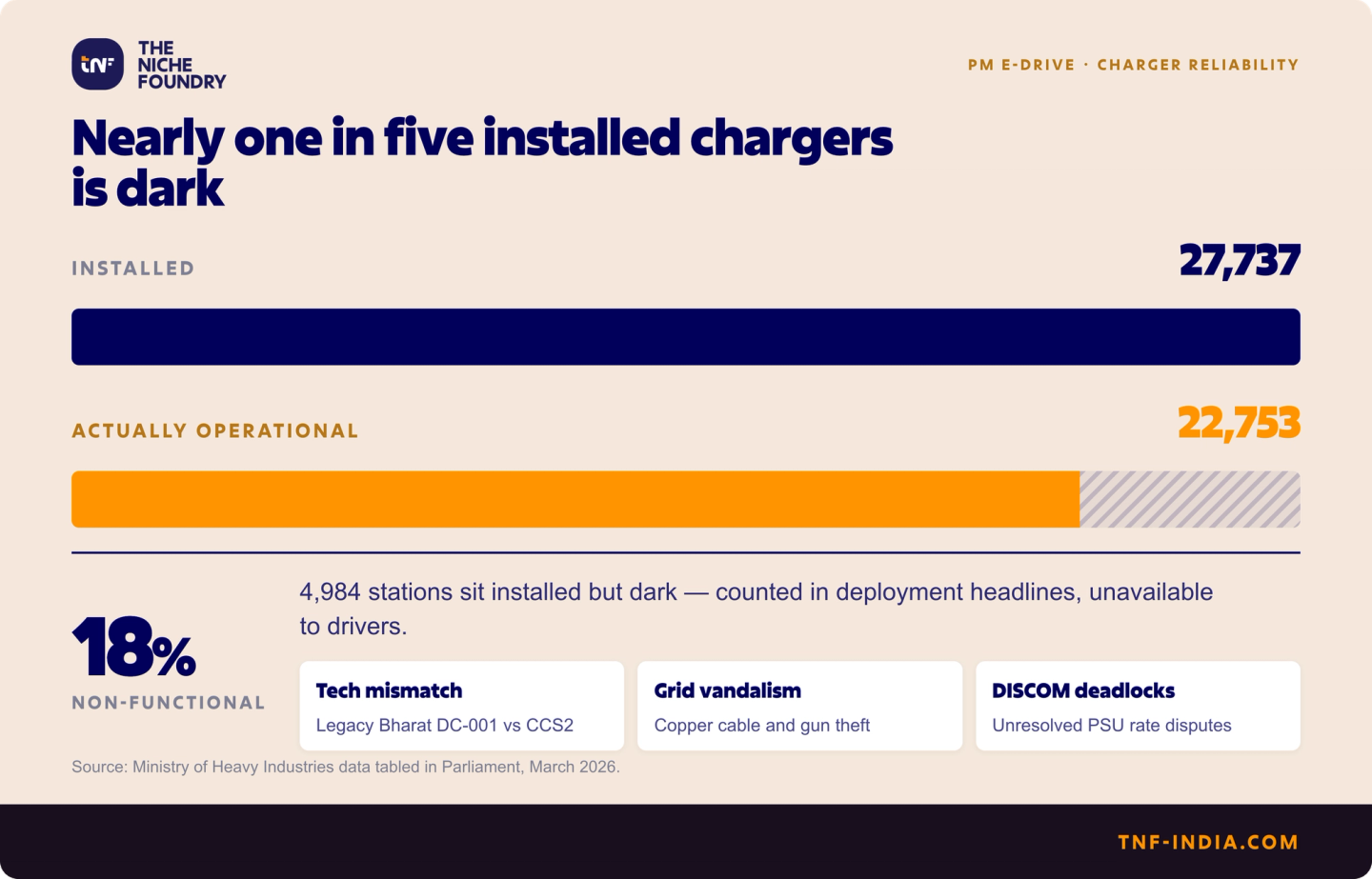
Source: Ministry of Heavy Industries, tabled in Parliament, March 2026
Many states have first-generation chargers (Bharat DC-001, 15 kW) that are incompatible with CCS2, the dominant fast-charging standard for four-wheel EVs. While Bharat DC-001 retains utility for the two- and three-wheeler segment, misaligned deployments for passenger car corridors are generating significant stranded infrastructure risk. Outdated technology will lead to underutilisation of these stations, which in turn exacerbates maintenance issues.
Poor maintenance issues still prevail in major cities like Delhi and other states caused by loss of charging equipment, no electricity supply, and no legitimate EV reserved parking. One of the reasons for charging unreliability is the rising theft of charging guns and copper cables.
Many users also report that charging speeds committed at 60 kW/unit deliver only 49 kW/unit. A 2024 IEEFA briefing note found that nearly 84% of EV chargers examined in Delhi were non-functional, primarily due to theft of charging equipment and lack of maintenance. Separately, a 2024 survey by Park+ of 500 EV car owners across Delhi NCR, Mumbai, and Bengaluru found that 88% cited difficulty locating accessible, safe, and operational charging stations as their primary concern.
Grid unpreparedness is equally responsible for the idleness at PSU-operated charging stations, where unresolved disputes with state DISCOMs continue to cut power supply to otherwise functional infrastructure. While the Ministry of Housing and Urban Affairs amended Model Building Bye-Laws mandate that 20% of parking in all residential and commercial spaces have allotted EV charging facilities, there is still a long way to go.
The impact of poor quality charging infrastructure directly affects revenue generation. Charging station owners' earnings depend on the energy usage per station. Currently, the utilisation of public EV charging stations is around 5%, which means a prolonged payback period. Likewise, private sector companies are also a bit reluctant to invest in charging stations due to less profitability.
Charging station owners typically earn Rs15–20/kWh per user. The location and reliability of the charging stations play a critical role in the number of vehicles charged per day. That way, owners have to ensure functional charging stations and uninterrupted power supply, making it a vicious cycle.
Additionally, setting up a charging station involves high upfront costs of charging equipment and land. Land acquisition is the biggest bottleneck due to bureaucratic delays and soaring land costs. To circumvent high land costs, owners set up stations where costs are low, typically low demand areas. Low demand implies fewer vehicles charged per day, and, consequently, reduced revenue.
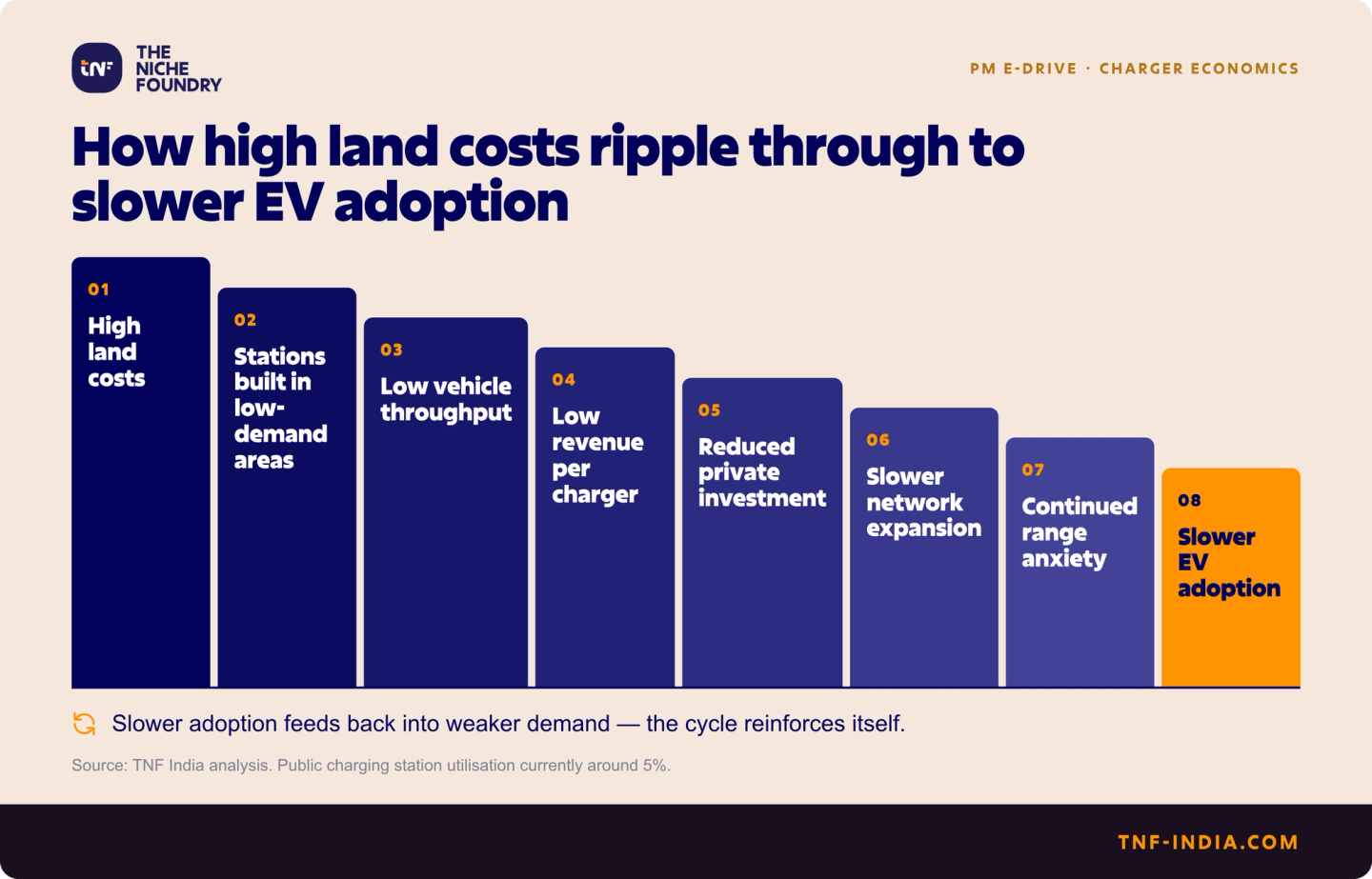
Source: TNF India analysis; 5% utilisation: S&P Global's
While GST on EV charging equipment has been reduced from 18% to 5%, the service of charging a vehicle at a public station continues to attract 18% GST. This imbalance that compresses operator margins is currently under review by the GST Council.
Revenue-sharing models with subsidised rates for land have also been implemented, but setting up a charging station is a decision with its own set of considerations. Analysis of user needs and demand patterns, infrastructure, and grid capacity are all important. Failure to do so jeopardises accessibility and operational efficacy. This impacts infrastructure expansion and ultimately EV penetration.
Emerging commercial models are beginning to address the high upfront costs of charging infrastructure. For instance, charging-as-a-service (CaaS) enables a charging operator to install and manage the station while the site owner pays a fixed monthly fee. Likewise, in revenue share models, the land owner gives the space and the operator manages the infrastructure, with revenue split between them.
Public stations at malls, cafes, or rest areas are of great convenience. Consumers no longer need to hunt for charging stations or plan a dedicated trip for vehicle charging, allowing them to charge their vehicles while enjoying their leisure or transit breaks.
Imagine being on a road trip where you need to download three different apps just to pay for your vehicle charging. This cumbersome experience is getting in the way of widespread adoption for many EV users. Many EV operators have their exclusive apps or payment systems which can be cumbersome for users to access multiple charging networks, especially during long journeys. One more reason why private companies are hesitant to invest in charging stations where users are confined to particular payment networks.
Nevertheless, the government is actively working toward a Unified Bharat e-Charge (UBC) initiative to tackle fragmentation and adopt a standardised payment system. Until this comes into effect, EV operators can integrate common digital platforms such as Unified Payments Interface (UPI) or EV roaming through radio frequency identification (RFID) cards to discover, use and pay for charging, eliminating the need to maintain multiple apps.
While scaling charging infrastructure and improving charger economics remain critical to EV adoption, another concern is taking the centre stage: battery longevity. Bharat Heavy Electricals Limited (BHEL) has been designated as the nodal agency under PM E-DRIVE to develop this unified digital super-app for real-time slot booking and integrated payment.
DC fast charging has materially reduced charging downtime, with the fastest EVs currently available in India reaching 80% charge in as little as 18–20 minutes, equivalent to approximately 250–350 km of added range, compared with 30–60 minutes on typical 50–70 kW public chargers. However, frequent use of DC fast charging affects battery life significantly.
A 2025 analysis by GeoTab, a global telematics and fleet management company, of over 22,700 EVs found that usage under 12% DC fast charging witnessed an average annual degradation of 1.5%, whereas over 12% DC fast charging witnessed an average annual degradation of 2.5%.
The operational velocity of DC fast charging comes with a strict engineering trade-off: crossing the 12% usage threshold jumps annual battery degradation from 1.5% to 2.5%.
India’s electric mobility revolution has moved past the phase of fiscal outlays and vanity deployment metrics. The ultimate success of the PM E-DRIVE scheme will not be measured by how many thousands of plugs are live by 2028, but by the baseline resilience of the grids supporting them, the commercial viability of individual charging assets, and the standardisation of the consumer experience.
Policymakers: Codify interoperability by mandating Open Charge Point Protocol (OCPP) and Interface (OCPI) standards. Leverage public-private partnerships (PPPs) to guarantee consistent station maintenance and charging uptime.
Infrastructure developers and contractors: Perform rigorous audits of capital and operational readiness before committing to new project bids. Deploy advanced smart solutions for real-time diagnosis and predictive maintenance to mitigate failures and maximise station reliability.
Institutional investors: Move project valuation models away from the total number of plugs deployed. Make compliance with Open Charge Point Protocol (OCPP) and Interface (OCPI) standards a non-negotiable funding covenant.
Disclaimer: Content provided by TNF India is for informational purposes only. While we aim to provide accurate data and strategic insights, information is subject to rapid market and technological shifts. This content should not replace independent due diligence or professional consultation. TNF India bears no responsibility for any actions taken, or financial losses incurred, in reliance on this material.
What an owner should receive at handover, and what actually arrives.