Tuesday, 13 October 2026

Standardised reporting frameworks and expanding green finance channels are transforming sustainability from a compliance requirement into a primary catalyst for India's foreign capital inflows.
Standardised reporting frameworks and expanding green finance channels are transforming sustainability from a compliance requirement into a primary catalyst for India's foreign capital inflows.
 Priya Dialani
India pulled in a record gross $81 billion in FDI in FY2024–25, and investors increasingly say ESG readiness is one reason why. Environmental, social and governance (ESG) factors continue to determine long-term viability.
India attracts significant FDI as global markets reward its momentum in ESG integration. As one of the countries most exposed to climate change and natural disasters, India's ability to attract ESG-driven FDI is critical to tackling its social and environmental challenges. This is not the full story though.
Foreign direct investment (FDI) favours jurisdictions that integrate ESG into economic decision-making. Countries that synchronise ESG responsibilities with economic progress encourage sustainable competitiveness and attract higher investment volumes. Moreover, foreign investors view ESG-compliant firms as lower-risk and higher-quality targets.









Investors don't invest because a company has a high ESG score. They invest because ESG helps them understand long-term risks and opportunities. ESG is essentially a framework for assessing whether a business can create sustainable value over time.Shantanu Srivastava, Research Lead, Sustainable Finance & Climate Risk, South Asia, Institute for Energy Economics and Financial Analysis (IEEFA)
Yet, strong ESG disclosures alone rarely seal the deal; foreign capital uses sustainability as a risk filter, not a substitute for core commercial viability.
"Defining ESG policies is one thing, but implementing them consistently is what builds investor confidence. ESG helps investors assess risk, but investment decisions are ultimately driven by economic fundamentals such as infrastructure quality, logistics efficiency, labour productivity and policy stability." says Saon Ray, Senior Visiting Professor, Indian Council for Research on International Economic Relations (ICRIER).
According to the Ministry of Commerce and Industry (DPIIT), India received gross $81.04 billion in FDI during FY2024–25, a 14% increase from FY 2023-24. Governance quality and environmental transparency are key factors to drive this growth. Total FDI inflows since 2000 now exceed $1.1 trillion. Clean energy alone secured $4 billion in 2025, driven by round-the-clock (RTC) renewable tenders, battery storage emphasis and better auction designs that reduce investor risk perception.
"The most material aspect in assessing a company's ESG readiness is its climate readiness because that's what carries the greatest weight with investors and financial institutions globally,” says Srivastava.
According to him, renewable energy acts as a vital hedge against climate transition risks, allowing fossil-heavy portfolios to diversify and de-risk. This has been a key driver behind the surge of global capital into India’s clean energy market.
"Investors want to understand whether a company has the strategy, governance and capabilities to navigate the climate transition while capturing the opportunities it creates. What matters isn't every ESG metric; it's the issues that are material from an investor's perspective and have the potential to impact long-term business performance," he adds.
The services sector has attracted the highest FDI inflows in FY 2024-25 accounting for 19% of the total investment. Besides, renewable energy has gained massive attention as investments in this sector have grown 2.5x during 2022-2025.
Furthermore, the ESG performance of MSCI India Index constituents has improved over the last five years. The share of companies with average ESG ratings grew from 55% to 66% and low ESG ratings decreased from 39% to 26% as of 2024.
The MSCI India Selection Index proves that ESG-focused portfolios deliver competitive financial results. Robust ESG practices enhance financial performance, thereby boosting investor appeal. While strengthening ESG practices, companies are improving their financial performance, making them attractive for foreign investors.
Ray believes that investors ultimately assess the governance quality. She adds, "Investors look closely at governance indicators such as board oversight, audit quality, regulatory compliance and supply chain management because these provide insight into long-term business resilience."
ESG disclosures and transparent reporting are critical to building investor confidence and attracting foreign investment. When aligned with industry standards, these disclosures lower equity capital costs and facilitate capital entry.
With the introduction of the Business Responsibility and Sustainability Report (BRSR) framework in 2021, the Securities and Exchange Board of India (SEBI) has enhanced ESG reporting in India in a standardised manner. From FY2022–23, BRSR became mandatory for the top 1,000 listed companies, requiring them to disclose their ESG performance. The subsequent 'BRSR Core' update mandates additional KPIs, with reporting requirements extending to 1,000 firms by FY2026–27.
Firms that comply with BRSR tend to gain more favour from foreign investors, as higher ESG disclosure correlates with stronger performance. These disclosures signal a commitment to responsible conduct and long-term value. Moreover, including labour practices or data privacy into ESG metrics offers a clear view of risks and opportunities.
ESG-focused investors view disclosures as evidence of superior management and future-readiness. This resilience drives demand, lowers capital costs, and secures higher firm valuations.
Since FIIs require consistent data, reliance on voluntary disclosures and the absence of independent audits erode investor confidence. "I haven't seen investors making decisions purely because of ESG ratings. Ratings are one input; they don't replace an investor's assessment of business fundamentals," says Srivastava.
Investors are interested not only in where a company stands today but also in how it plans to reduce its carbon footprint over the coming years.Saon Ray
According to India Brand Equity Foundation (IBEF), India requires $2.5 trillion by 2030 to meet Paris Agreement commitments. Green finance, including bonds and sustainability-linked loans, helps drive environmental stewardship and increases FDI.
Green finance has significantly impacted the renewable energy sector with projects around wind, solar, and hydropower projects unlocking the most of these investments. For instance, the World Bank's two Low-Carbon Energy Programmatic Development Policy Operations, worth $3 billion combined, support green hydrogen production, renewable energy expansion and climate finance mobilisation in India.
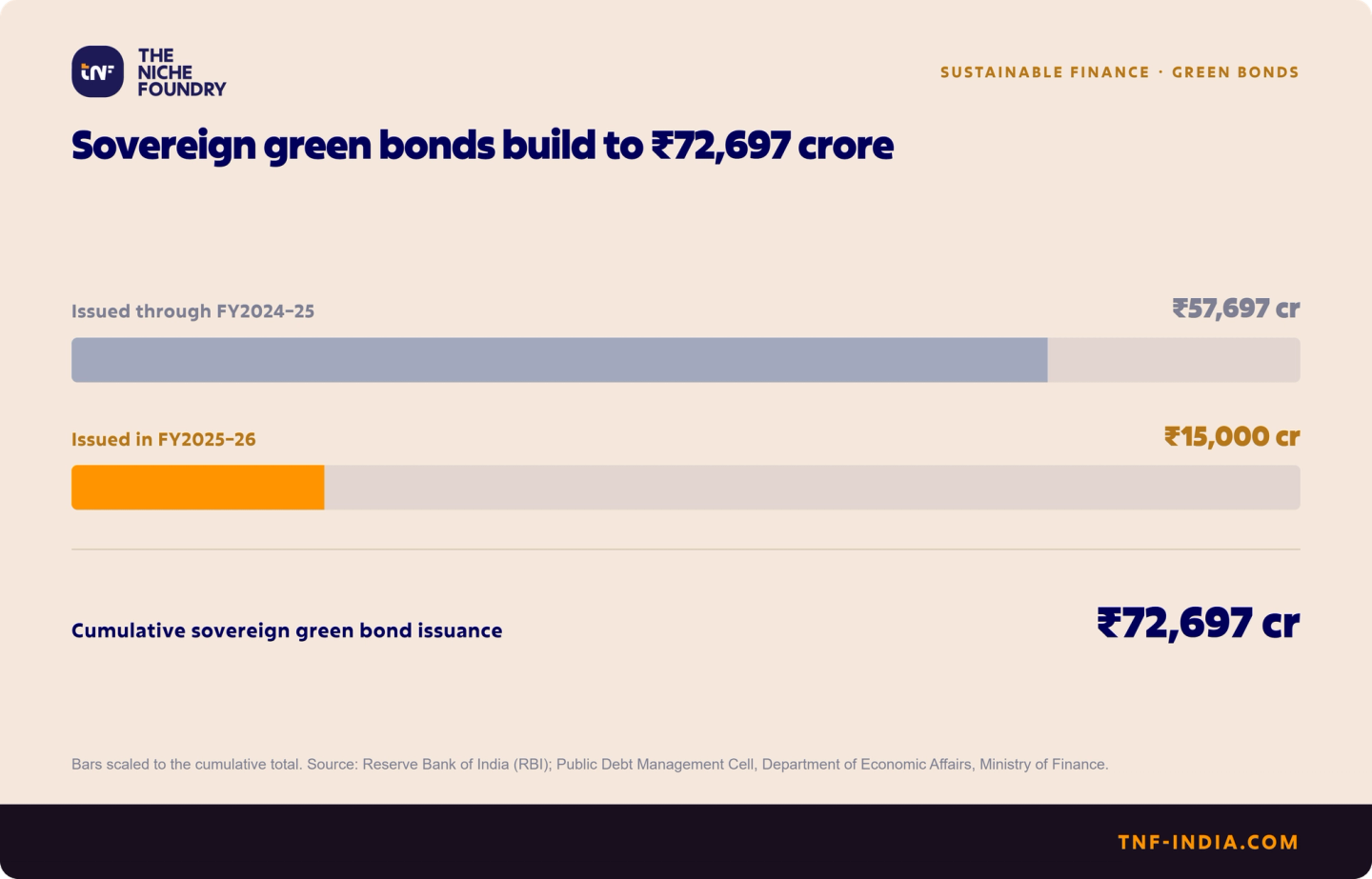
As one of the fastest-growing emerging markets for green bonds, rising capital inflows through this route can accelerate India's transition to clean energy. The government issued sovereign green bonds worth ₹15,000 crore in FY26, with the aggregate total reaching ₹72,697 crore.
As per Climate Bonds Initiative (CBI), by late 2024, India issued $55.9 billion in green, social, sustainability, and sustainability-linked (GSS+) debt, marking a 186% increase since 2021. Labelled green-loan deals alone reached $5.5 billion in 2024 across 19 corporations.
Sustainable finance currently accounts for just a portion of the global debt market, and these instruments will only reach the mainstream once capital providers systematically price climate risk into broader credit markets. Until then, commercial adoption relies strictly on financial incentives.
"Green bonds or any sustainable finance instrument will only matter if they provide a financial benefit to either the issuer or the investor," explains Srivastava. "The biggest benefit a green bond can offer is pricing advantage, or what the market calls 'Greenium'—the difference in borrowing cost compared to a conventional bond."
However, this pricing advantage has not unlocked capital evenly. While solar and wind absorb the lion's share of funding, hard-to-abate sectors like steel, cement, and urban infrastructure remain underfunded.

Srivastava notes that transitioning firms in heavy industry struggle to attract project-level foreign investment because they lack tangible, low-carbon assets on the ground that institutional investors can point to as clean allocations.
At the same time, government-led green financing options and incentives are necessary to help these smaller firms shoulder the burden of ESG compliance. "In the current bank-led financing mechanism in India, banks often struggle to lend to MSMEs for green activities because they find it difficult to assess the risks associated with these new, unfamiliar processes", Ray points out.

Beyond BRSR, Indian enterprises must also comply with international ESG regulations. The EU's Corporate Sustainability Reporting Directive (CSRD) mandates that EU firms report on their Indian suppliers' ESG performance or Indian MNCs that have ties with EU companies. Consequently, Indian suppliers must provide verified data to maintain their positions in EU supply chains.
Lack of interoperability with international ESG standards like Global Reporting Initiative (GRI) and the International Financial Reporting Standards (IFRS) issued by the International Sustainability Standards Board (ISSB), data quality, and enforcement disparities persist. Furthermore, varying net-zero commitments across sectors result in inconsistent BRSR disclosures.
IFRS S2, which now fully incorporates the former TCFD recommendations, requires joint ventures or supply chain partners to share climate data. Indian enterprises without robust ESG policies risk disqualification. ESG reporting is therefore critical for Indian companies with cross-border operations.
"ESG should be viewed less as a standalone investment criterion and more as a framework for evaluating long-term risks, resilience and opportunities. In India, the climate transition is creating significant opportunities for foreign capital, particularly in businesses that have credible transition strategies and are positioned for sustainable growth," says Srivastava. Global capital no longer treats sustainability as an isolated compliance exercise, but as a core component of operational health and risk management.
ESG and business fundamentals should not be viewed separately. Investors evaluate both together before making investment decisions.Saon Ray
Disclaimer: Content provided by TNF India is for informational purposes only. While we aim to provide accurate data and strategic insights, information is subject to rapid market and technological shifts. This content should not replace independent due diligence or professional consultation. TNF India bears no responsibility for any actions taken, or financial losses incurred, in reliance on this material.
What an owner should receive at handover, and what actually arrives.