Tuesday, 13 October 2026

South Asia has spent two decades building cross-border transmission corridors. Can it create a regional market that extracts greater value from every megawatt?
South Asia has spent two decades building cross-border transmission corridors. Can it create a regional market that extracts greater value from every megawatt?
 Lalita Subrahmanyam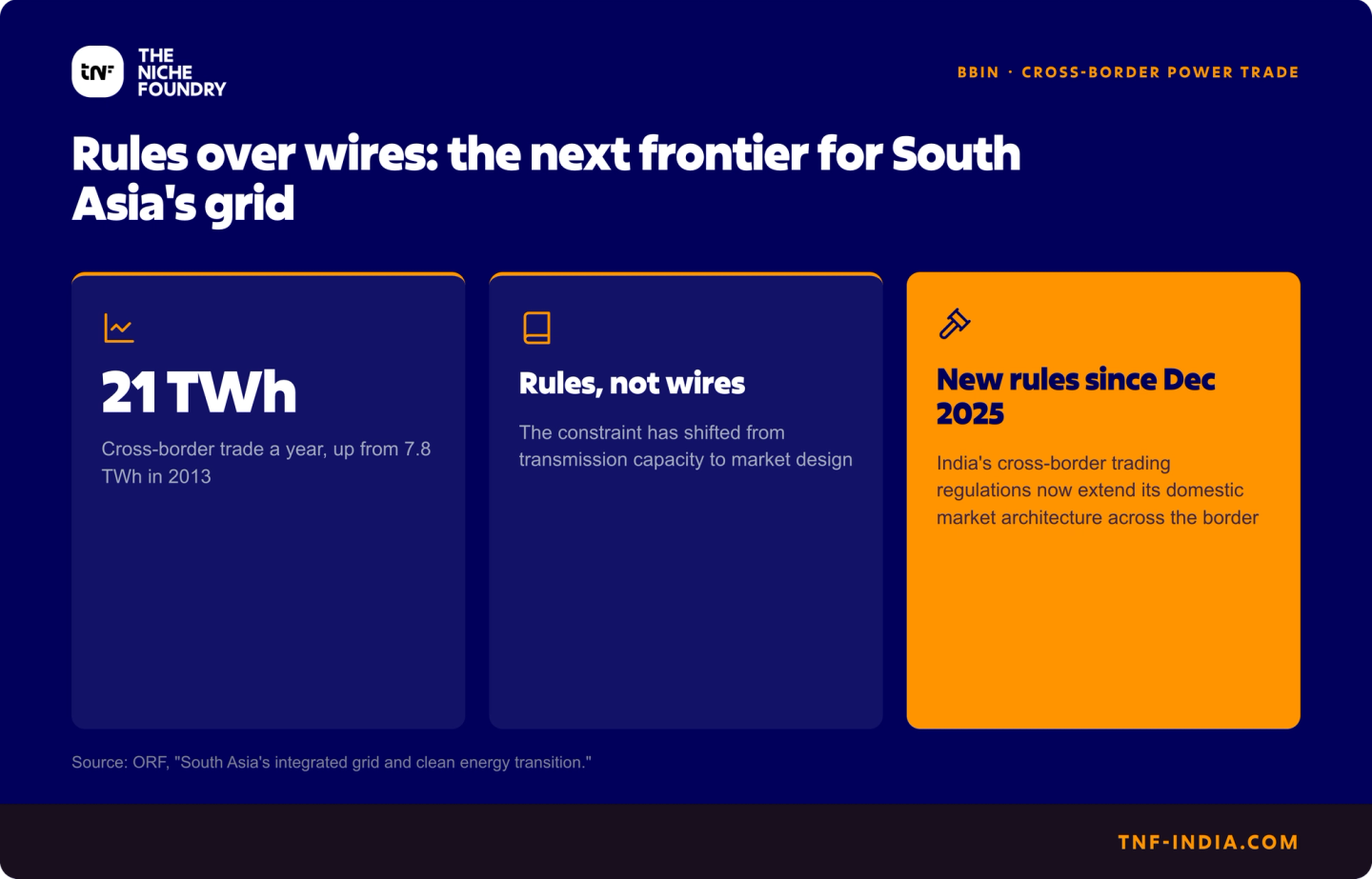









Cross-border electricity trade across South Asia has nearly tripled in a decade, from 7.8 TWh in 2013 to 21 TWh in 2024, yet it still uses only a fraction of the region's transfer capacity.
For two decades, the governments of Bangladesh, Bhutan, Nepal and India (BBIN) focused on expanding generation capacity, constructing transmission corridors and strengthening bilateral power agreements. The results are visible. India's cross-border transmission network now exceeds 10 GW of transfer capability. A study under USAID's South Asia Regional Initiative for Energy Integration (SARI/EI), whose activities now continue through the South Asia Regional Energy Partnership (SAREP), estimates the region's full cross-border trade potential at 43.8 GW by 2043. These ambitions are closely aligned with India's target of 500 GW of non-fossil fuel capacity by 2030, announced as part of its COP26 commitments.
A regional market flattens seasonal demand swings, lowers reserve margins and outage risk, and improves utilisation of existing transmission assets, the same benefits India's own domestic market reforms have already demonstrated at scale.
Currently BBIN electricity trade utilises only a fraction of this extensive infrastructure. The reason has less to do with engineering than economics. The challenge has shifted from building infrastructure to designing markets.
The challenge has shifted from building infrastructure to designing markets.
CBET within the BBIN subregion relies on a structured hierarchy of agreements. The network operates through comprehensive multilateral umbrellas, localised bilateral treaties, and trilateral grid supply contracts.
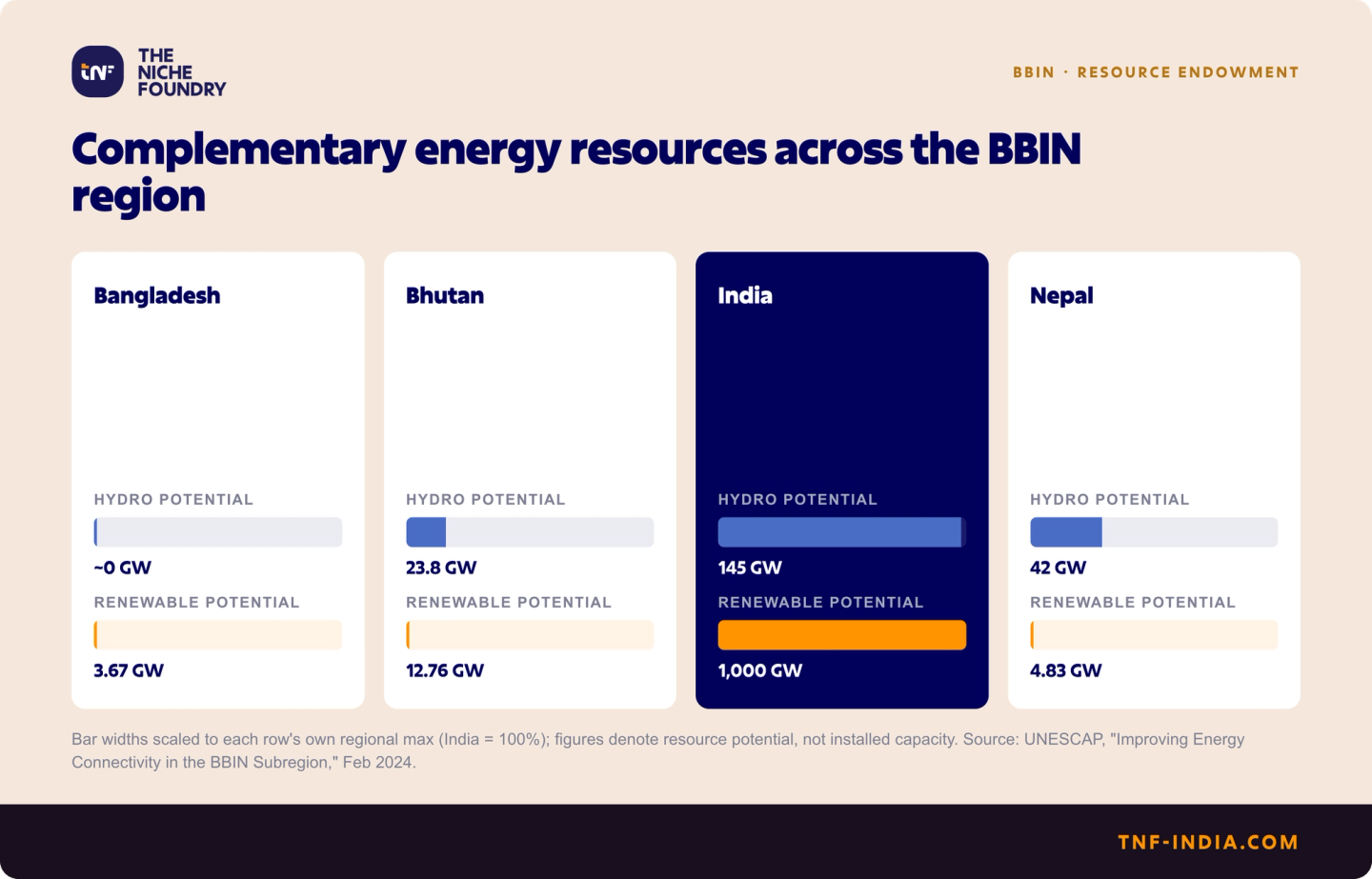
Source: UNESCAP, Improving Energy Connectivity in the BBIN Subregion, February 2024
The BBIN region possesses highly complementary energy resources. Integrating solar power with run-of-river (RoR) hydro assets creates a highly efficient 24-hour supply cycle. Bhutan and Nepal hold some of South Asia's largest untapped hydropower reserves (Nepal alone has an estimated 83 GW of potential, with barely 1% developed so far), while India combines large renewable capacity with the region's deepest electricity market. As India's solar power meets the demand during the day, Nepal and Bhutan's hydro can supply evening peaks. Bangladesh contributes stable demand, creating a natural commercial ecosystem for cross-border trade.
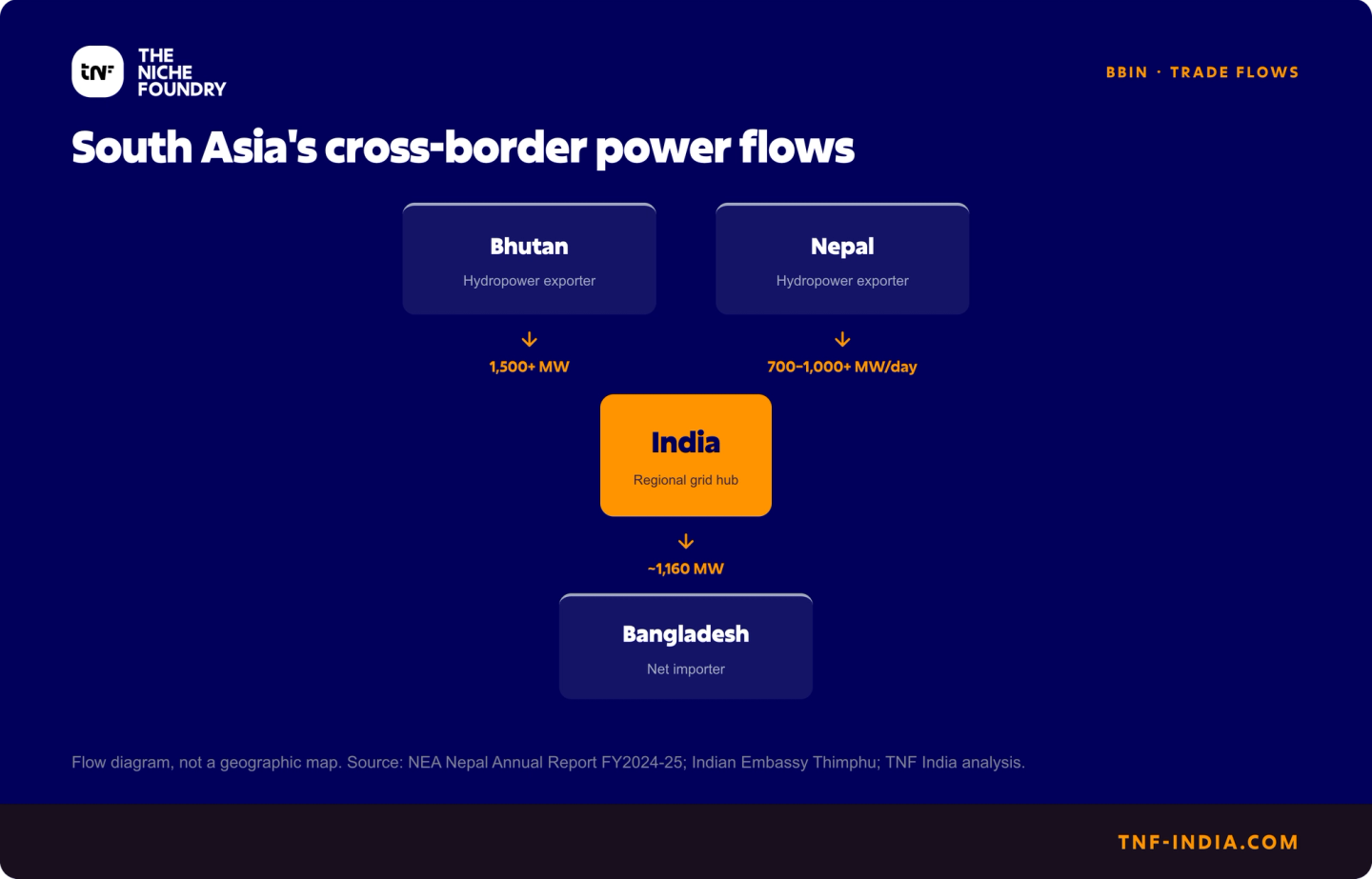
Bhutan exports over 1,500 MW of hydropower to India under long-term Power Purchase Agreements. The original bilateral target, 10,000 MW of hydropower development, was set for 2020, not 2030, and has been substantially missed: installed capacity stands at roughly 3,490 MW today.
Nepal has evolved from a seasonal importer into an active market participant. Nepal's total cross-border electricity exports reached 3.88 billion units in FY2025-26, up from 2.38 billion units the prior year, with daily exports now running 700 MW to over 1,000 MW in peak season. New transmission corridors are under construction, though timelines have slipped: the Gorakhpur–New Butwal line, rated at up to 3,500 MW, is expected to complete its Nepal section by August 2026 and its substation only by December 2027, running at reduced interim capacity in the meantime.
Bangladesh imports around 1,160 MW of electricity from India, and has been importing Nepalese hydropower through the Indian grid since October 2024 under a trilateral Power Sales Agreement, which expanded from 40 MW to 60 MW before a further expansion was blocked pending India's approval in mid-2026.
Taken together, as per the Interstate Transmission System rolling plan 2030-31 by the Central Transmission Utility of India Limited, these interconnections have an installed transmission capacity of 10,323 MW, facilitating operational power transfer of about 5,414 MW, leaving uncommitted transmission headroom of nearly 4,909 MW. By 2027-28, installed capacity is expected to increase by another 8,100 MW through interconnections under construction, taking operational power transfer to about 9,194 MW.
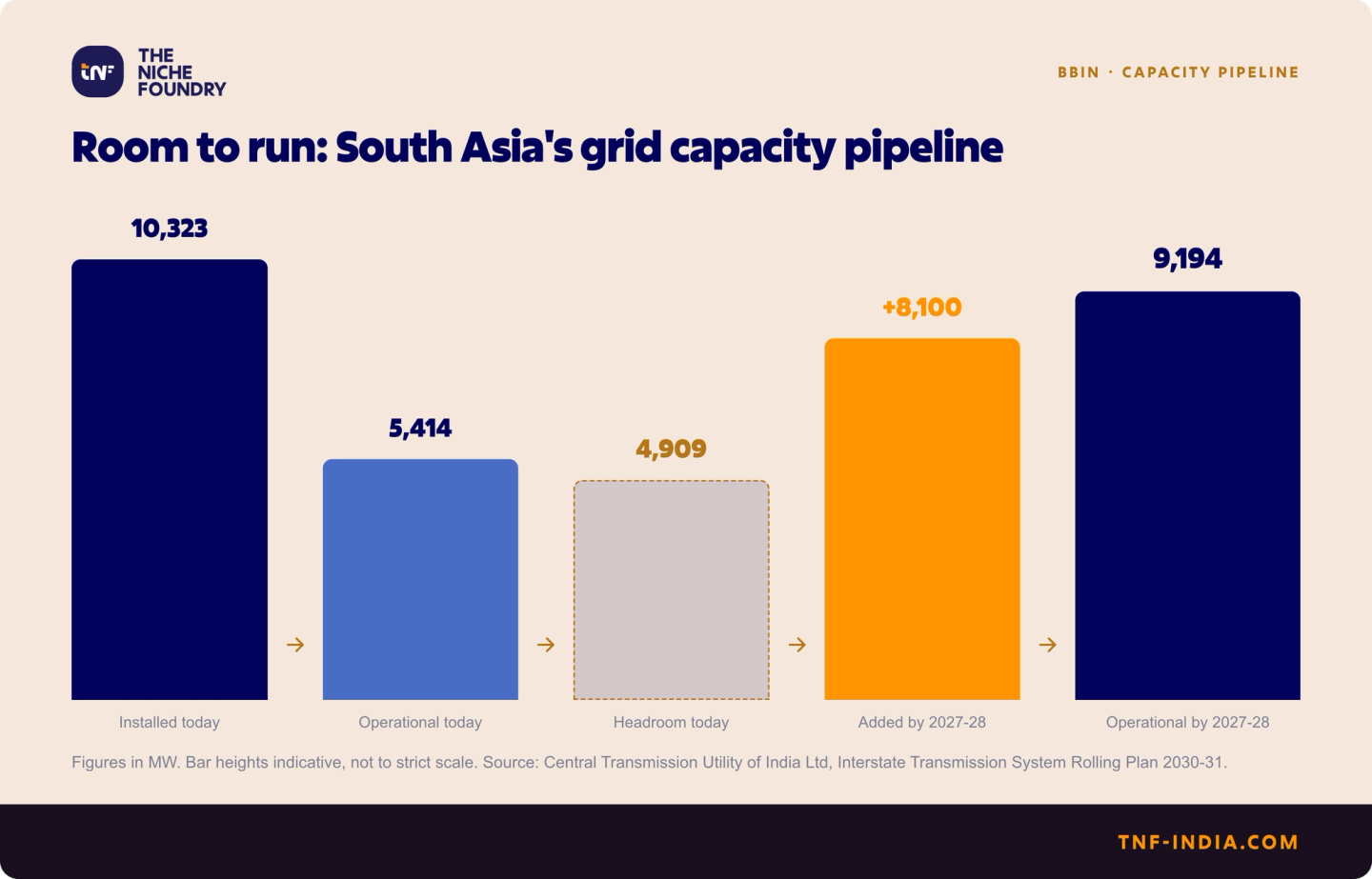
That leaves close to 5 GW of headroom commercially underutilised today, rising toward 9 GW as capacity under construction comes online by 2027-28. The constraint is not resource availability anymore. It is market access.
The constraint is not resource availability anymore. It is market access.
Electricity markets cannot scale unless neighbouring grids operate with high levels of stability. Frequency synchronisation, reserve sharing, congestion management and transmission reliability determine how much electricity can move safely across borders. This is why the debate around alternating current and high voltage direct current interconnections matters.
Alternating current systems operate efficiently when interconnected grids maintain close synchronisation.
High voltage direct current (HVDC) systems provide greater operational control, support longer transmission distances and allow asynchronous systems to exchange power more flexibly.The technology decision therefore becomes a commercial decision.
Every improvement in grid flexibility expands the number of buyers and sellers capable of participating in regional trade. In other words, infrastructure enables electricity to move. Grid synchronisation determines whether markets can grow.
Grid synchronisation determines whether markets can grow.
Technical integration alone will not unlock opportunities for growth. Commercial integration must follow. This is where solar and hydropower create one of the region's strongest competitive advantages. India's renewable programme increasingly produces surplus solar generation during daylight hours. Managing this surplus is becoming more important as renewable penetration increases.
Hydropower from Nepal and Bhutan offers a complementary resource. Unlike solar generation, hydropower acts as a balancing service, offering operational flexibility during evening demand peaks and periods of renewable variability. The strategic opportunity therefore extends beyond electricity supply.
Every unit of flexible hydropower reduces renewable curtailment, improves system stability and increases the productivity of India's solar investments. Electricity trade is increasingly about monetising flexibility.
The region's first generation of electricity trade relied on government negotiated bilateral agreements. Those agreements remain essential. They are unlikely to deliver the scale required for the next decade.
Larger markets require transparent pricing, congestion management, market-based dispatch, settlement systems and open access participation. India has already begun moving in this direction.
The CERC (Cross Border Trade of Electricity) (Second Amendment) Regulations, 2025, notified in December 2025, now extend General Network Access (GNA) and Temporary GNA principles to cross-border electricity transactions, aligning charging, scheduling and curtailment with India's domestic market architecture.
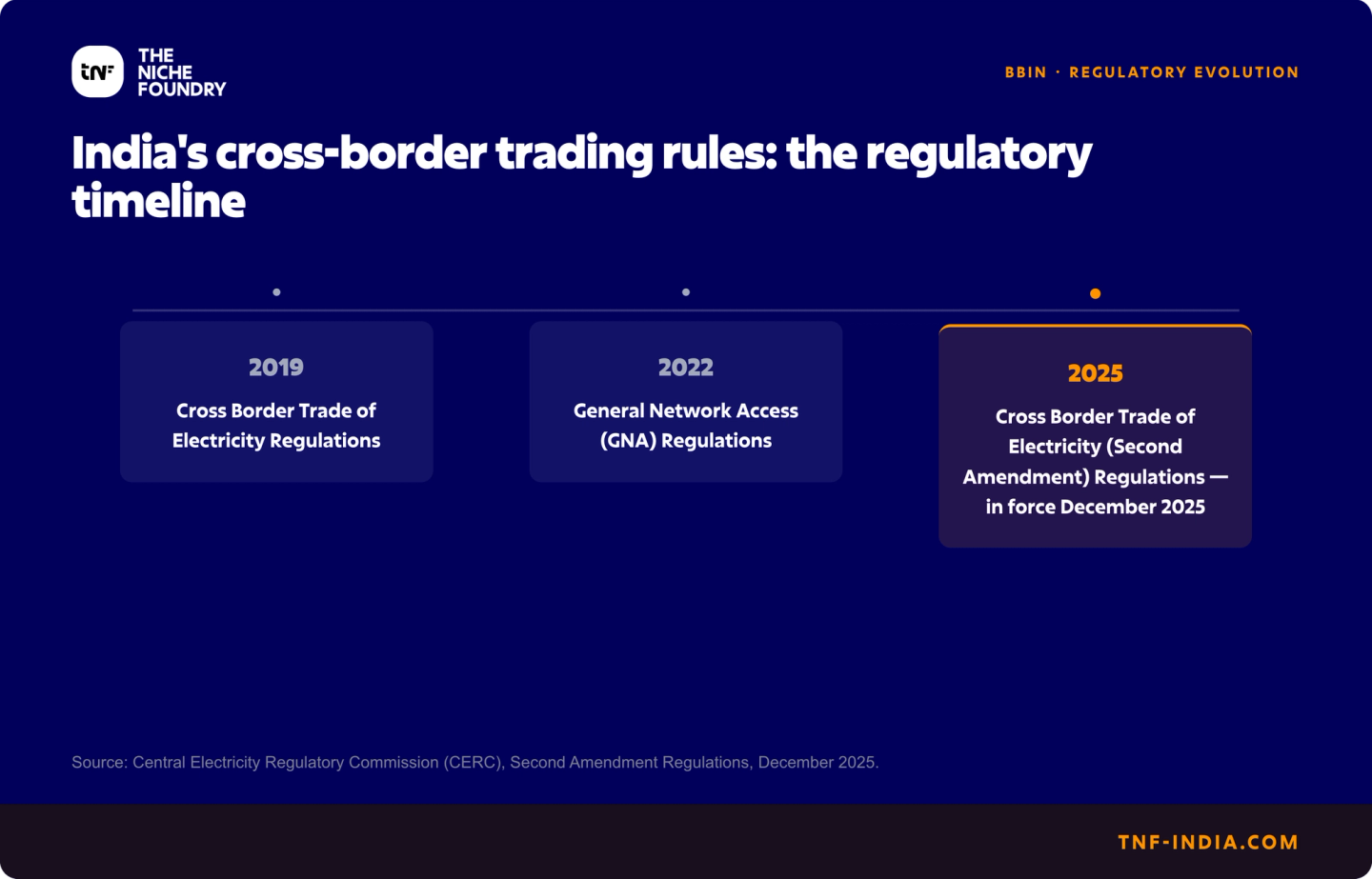
South Asia has already invested heavily in power generation assets as well as transmission corridors. The future of regional integration requires a different form of investment. Market institutions must now evolve as quickly as physical infrastructure. Cross-border market transactions currently leverage India's domestic power exchange architecture, including the Indian Energy Exchange (IEX) and Hindustan Power Exchange (HPX).
Rules governing congestion management, cross-border settlement, balancing services and predictable open access frameworks will determine whether today's transmission corridors become tomorrow's cross-border trading platform.
Power generators: Diversify revenue by participating in multiple regional markets. Position hydropower as a balancing service alongside energy supply. Structure projects around long term market access rather than individual buyers.
Grid operators: Strengthen frequency management and reserve sharing. Prioritise transmission investments to unlock additional market participation. Expand congestion management capabilities.
Power exchanges: Develop products tailored to regional electricity trading. Improve liquidity across cross-border markets. Standardise settlement mechanisms for neighbouring participants.
Policymakers: Harmonise market rules across BBIN countries. Accelerate open access implementation. Align regulatory frameworks with regional rather than purely national objectives.
Investors: Evaluate market infrastructure alongside generation assets. Support transmission projects that improve market connectivity. Target flexibility services as renewable penetration increases.
Disclaimer: Content provided by TNF India is for informational purposes only. While we aim to provide accurate data and strategic insights, information is subject to rapid market and technological shifts. This content should not replace independent due diligence or professional consultation. TNF India bears no responsibility for any actions taken, or financial losses incurred, in reliance on this material.
What an owner should receive at handover, and what actually arrives.