Tuesday, 13 October 2026
What operators must do now, before the next disruption forces their hand.
What operators must do now, before the next disruption forces their hand.
 Lalita Subrahmanyam
In February 2026, the Strait of Hormuz was not physically blocked. Within 48 hours of US-Israeli strikes on Iran, war-risk premiums surged fivefold, existing coverage was terminated, and replacement quotes arrived at roughly 60 times pre-crisis rates. . Insurance had made the voyage commercially unviable before a blockade could.









Layered on top of two years of Red Sea disruption that had already pushed container surcharges to $4,000 a box and stretched transit times by up to 20 days, this is no longer a crisis. It is the operating environment, and Indian operators pricing freight on pre-2023 assumptions are absorbing the consequences in real time.
For many Indian importers of rice, textiles, or low-value industrial goods, an extra $2,000 to $3,000 per box in surcharges can wipe out margins or render the shipment unviable. There is the additional burden of 10 to 20 extra days in transit due to re-routing and congestion. India's import of crude oil is severely affected by its need to transit through high-risk maritime zones. For operators, the surcharge is a semi-fixed tax that can consume margins, unless renegotiated, re-routed, or reinsured.
War-risk surcharges were once triggered by discrete events: piracy, regional flare-ups, and they quickly reversed. Today, they are recurring cost variables on major routes, driven by persistent geopolitical instability that shows no sign of resolution.
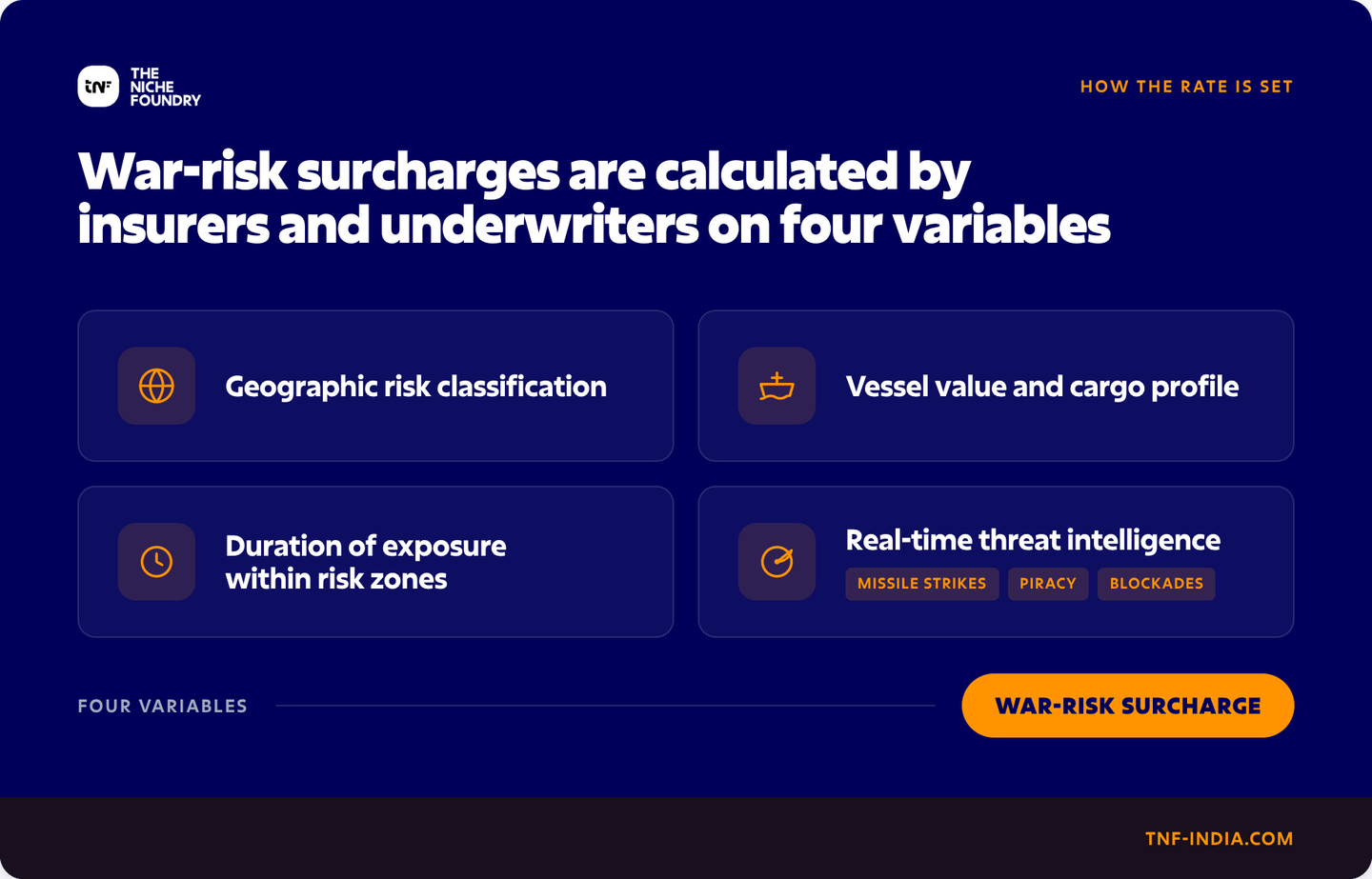
War-risk premiums in the Red Sea surged as much as 20-fold in January 2024, per insurance industry reports, and remained substantially elevated in early 2026. For the Strait of Hormuz escalation that began in February 2026, premiums surged fivefold within 48 hours, with some quotes reaching up to 60 times pre-crisis rates. Per-voyage insurance costs have risen from 0.05% to 1 to 3% of vessel value, depending on vessel type, ownership, and route.
Shipping lines pass additional costs downstream. The burden then cascades through the supply chain. Freight forwarders add buffers. Importers absorb what cannot be passed on, and end consumers bear the inflationary impact. Timing matters because freight costs adjust instantly, while downstream pricing lags. This creates margin compression at the operator level.
For sectors like chemicals, fertilisers, and electronics, where India is heavily reliant on imports, the pass-through is incomplete, creating sustained cost pressure. Shippers get billed for war-risk surcharges, often in addition to pre-agreed freight contracts where the carrier can unilaterally change the tariff mid-year. The Federation of Freight Forwarders' Associations in India (FFFAI) has urged the Ministry of Ports, Shipping and Waterways to regulate surcharges it describes as 'arbitrary'.
The leverage has to come from the contract itself. Operators should negotiate ownership of the freight basket, insist on multi-carrier and multi-risk clauses, and build in exit triggers that activate when war-risk charges breach agreed thresholds. Without these, every surcharge spike becomes a cost the operator absorbs by default.
Once shipping lines reprice, every downstream layer follows: insurance premiums, freight rates, and surcharges move in sequence, compounding the burden on operators who control none of these inputs. The combined Red Sea and Hormuz disruptions affect approximately 50% of India's exports by value: those routed to Europe, North America, North Africa, and part of the Middle East through the Suez Canal and Gulf corridors. Segments like textiles, agriculture, low-margin engineering, and auto-parts cannot absorb logistics shocks without cutting prices, reducing volumes, and pushing factories into downtime.
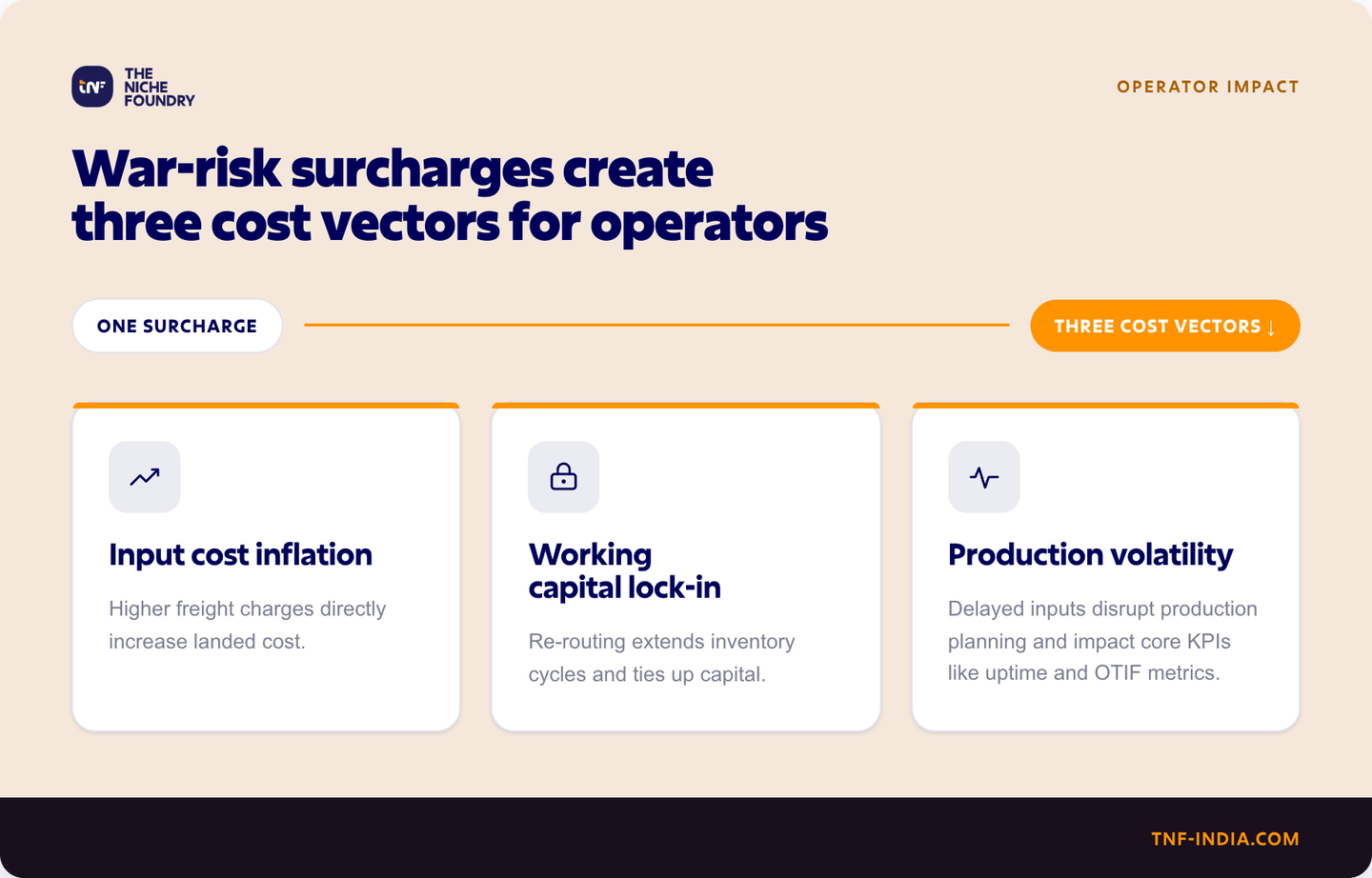
Fuel and imported input categories are highly sensitive to freight shocks, leading to broader inflation, eroding consumers' buying power and affecting sales. Operators who cannot pass on freight costs face a binary choice: absorb the compression or cut production. Rising costs of transport (linked to fuel costs) and fertilisers have an impact on the cost-of-living and ultimately, food security.
There is an urgent need for risk mitigation strategies. Operators need to treat freight as a per-lane, per-quarter cost line and a risk-bucket tied to geopolitics, conflict cycles, and insurance premium arcs, and re-allocate volumes across lanes, products, and regions.
When a route is blocked by conflict, the idea is not to find the cheapest alternative or take a longer route. The advantage shifts to smart operators who prioritise controllability over cost and pre-own viable re-routing channels around conflict zones.
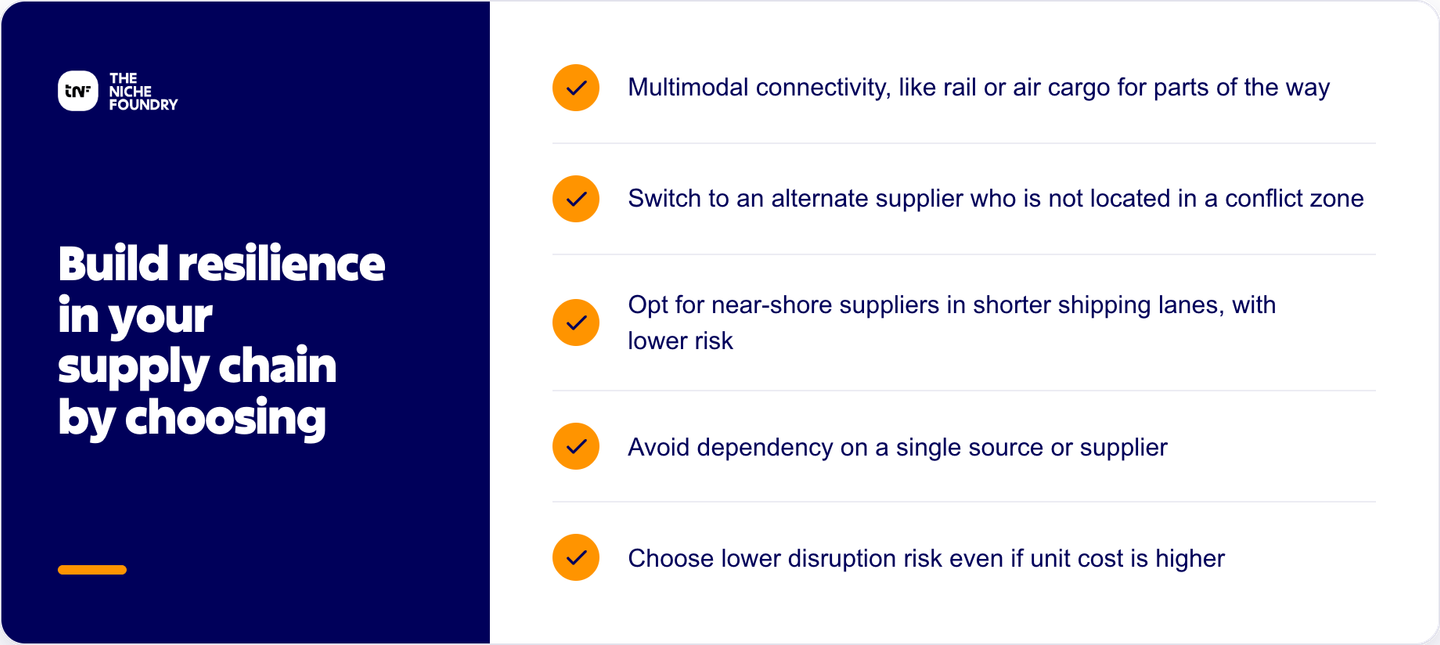
India is also pushing for localised production that reduces dependency on imports, but needs time for the plan. Operators who assume that the rates will normalise to pre-2020 levels, adhere to single-lane shipping strategies, and treat insurance as a static annual contract without redesigning the systems may find themselves at an enormous disadvantage.
As war-risk premiums escalate, reaching 1 to 3% of vessel value for standard routes and higher for specific high-risk vessel types, standard marine cargo policies frequently fail to provide adequate conflict-zone coverage. Typical marine cargo policies do not explicitly cover conflict-zone losses, piracy, or risk of seizure by the state.
Insurance is now a control layer. Operators who treat it as anything less are delegating their risk tolerance to intermediaries.
Operators should cap risk by mandating explicit coverage clauses for war risk, even if it pushes the premium band higher. Another strategy would be to get dual insurance coverage, with one specifically covering conflict risk and another covering standard loss, delay, and damage. By treating insurance as a structural control point, operators can set a limit on their tolerance for war risk.
Insurance for Indian operators is a critical, under-managed lever, and war-risk insurance premiums are volatile. As we saw in 2024 and earlier this year, costs can spike without warning as conflicts escalate. With increasing coverage restrictions on conflict escalation scenarios, claims settlement timelines are lengthening. When some routes are classified as enhanced risk zones, insurers will require separate underwriting approvals per voyage. This can lead to unpredictability in costs, coverage gaps during escalation, and limited negotiating leverage with insurers.
Way ahead
Operators: Reprice contracts with dynamic freight clauses, and create supply chain redundancy. Diversify supplier base; build inventory buffers; integrate risk-adjusted cost modelling into procurement.
Policymakers: Fast-track the development of multimodal corridors. Create a fund or framework to protect small exporters from facing unilateral surcharges. Identify which products and routes can be de-risked.
Manufacturers: Align pricing strategy with fluctuating landed costs. Redesign SLAs to reflect realistic delivery timelines under re-routed shipping conditions.
Disclaimer: Content provided by TNF India is for informational purposes only. While we aim to provide accurate data and strategic insights, information is subject to rapid market and technological shifts. This content should not replace independent due diligence or professional consultation. TNF India bears no responsibility for any actions taken, or financial losses incurred, in reliance on this material.
What an owner should receive at handover, and what actually arrives.