Tuesday, 13 October 2026

Why India's green hydrogen ambitions now depend on infrastructure, technology selection, and global market access.
Why India's green hydrogen ambitions now depend on infrastructure, technology selection, and global market access.
 Lalita Subrahmanyam
Every oil price spike hits India harder than most. With approximately 87% of its crude imported and an annual fossil fuel bill that has crossed $100 billion, India's economy runs on energy it neither controls nor produces. That vulnerability is not new, but the urgency to address it is.
Green hydrogen, produced from India's rapidly cheapening renewables, is the most credible path to changing the equation: clean energy made at home, at falling cost, with the potential to export. Hydrogen can help reduce crude oil dependency and decarbonise industries across fertiliser, steel, refining, and mobility. The policy framework is ready, but the physical infrastructure is missing. Closing this critical execution gap is the defining challenge of the decade.
Green hydrogen can be produced through electrolysis and using renewable energy with near-zero lifecycle CO₂ emissions. It is unlike grey hydrogen, which is produced from natural gas (Steam Methane Reforming) with significant CO₂ emissions. can be classified as grey. Cheap renewables can give India a competitive edge in producing and exporting green hydrogen at progressively lower cost.









LCOH is the per kilogram cost of producing hydrogen over the asset's lifetime. Producers need to win the race to cost parity by quickly driving down the LCOH.
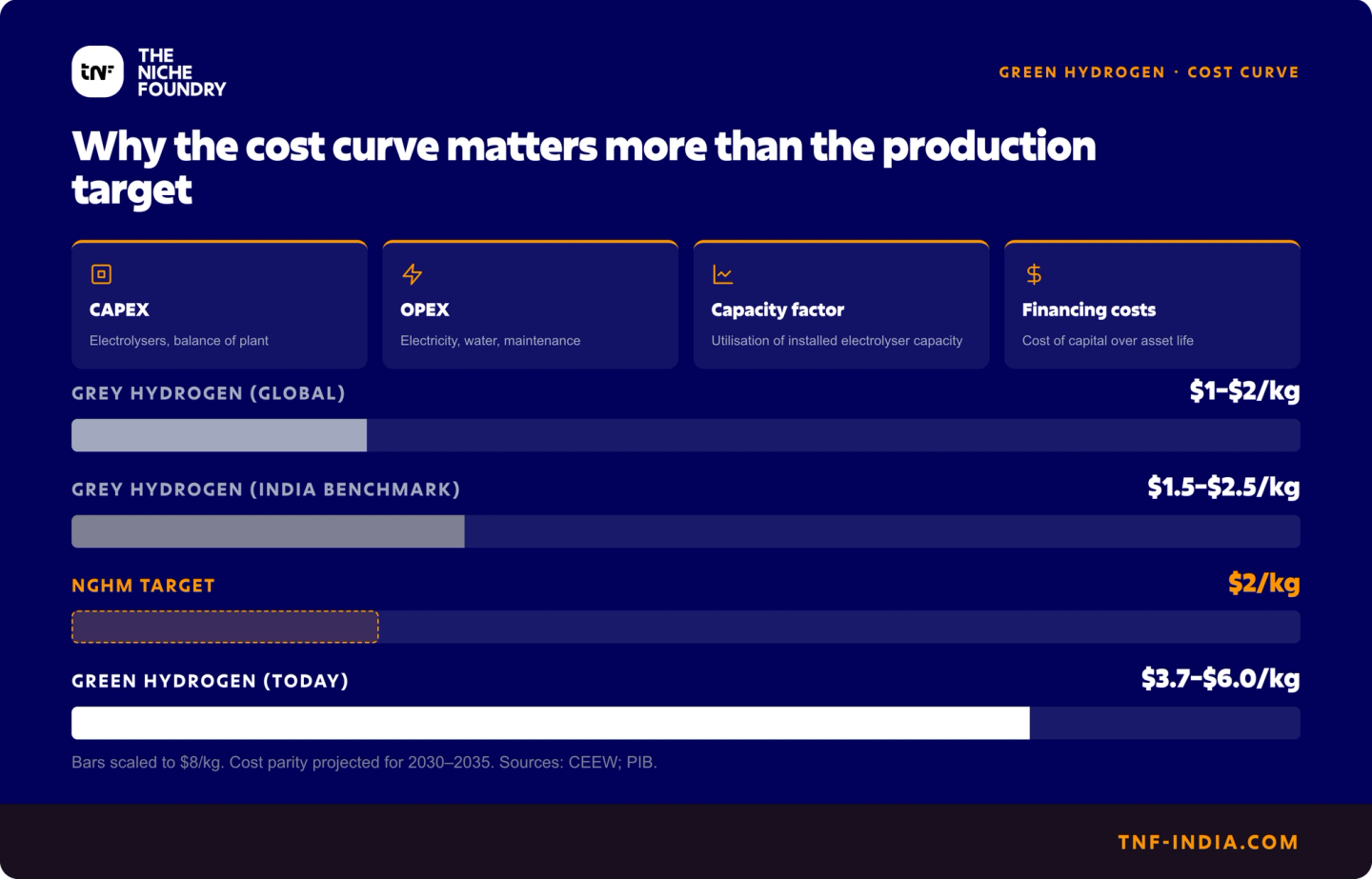
Grey hydrogen's LCOH is typically $1–$2/kg, depending on regional natural gas prices. In India, where gas is largely imported, the relevant benchmark is closer to $1.5–$2.5/kg. Solar/wind and electrolyser LCOH stood historically at $4–6/kg. India stands to gain by reducing green hydrogen LCOH driven by declining renewable energy tariffs, lower tech costs, higher capacity utilisation. Projections slate cost parity for 2030–2035. Reaching this window will break the sector's reliance on policy subsidies, unlocking true market-driven deployment and mass-manufacturing volumes.
Policy as a catalyst: de-risking India's hydrogen pivot
Strategic Interventions for Green Hydrogen Transition, also known as SIGHT, is a government scheme that aims to promote the domestic production of green hydrogen by aggregating demand, creating a market, mitigating risks in investment, and offering incentives and support to ensure viability.
The SIGHT scheme is specifically structured to ensure project bankability. In 2023, the Union Cabinet approved a National Green Hydrogen Mission (NGHM), that aims to produce 5 MMT per annum while ensuring the addition of renewable energy generation capacity of about 125 GW, at an initial outlay of ₹19,744 crore ($2.3 billion). SIGHT earmarks ₹17,490 crore for various initiatives like providing capital subsidies to the manufacturers of electrolysers.
What an owner should receive at handover, and what actually arrives.