Tuesday, 13 October 2026

India's grid has no shortage of energy; it has a shortage of energy it can count on. SMRs are the small, solid block that turns intermittency into order.
India's grid has no shortage of energy; it has a shortage of energy it can count on. SMRs are the small, solid block that turns intermittency into order.
 Lalita Subrahmanyam
India's grid is not short of megawatts. It is short of megawatts that show up at midnight, in December, when a smelter is running at full draw and the wind has been still for three days. The gap between installed capacity and firm, dispatchable power is the central fault line in India's energy transition.







Adding solar and wind energy to the grid is affecting baseload supply, industry uptime and frequency stability. With demand for electricity growing at over 6% annually, India's firm capacity additions are lagging behind expectations due to the retirement of coal, unavailability of gas, and intermittent renewable energy generation. Small modular reactors (SMRs) are being designed to close the gap.
SMRs offer a systems-engineering response to grid instability, industrial decarbonisation and capacity deficits. India allocated ₹20,000 crore for the R&D, design, and deployment of indigenous SMRs under the Nuclear Energy Mission as it plans to take nuclear power generation from the current 8,780 MW to 22,480 MW by 2031-32.
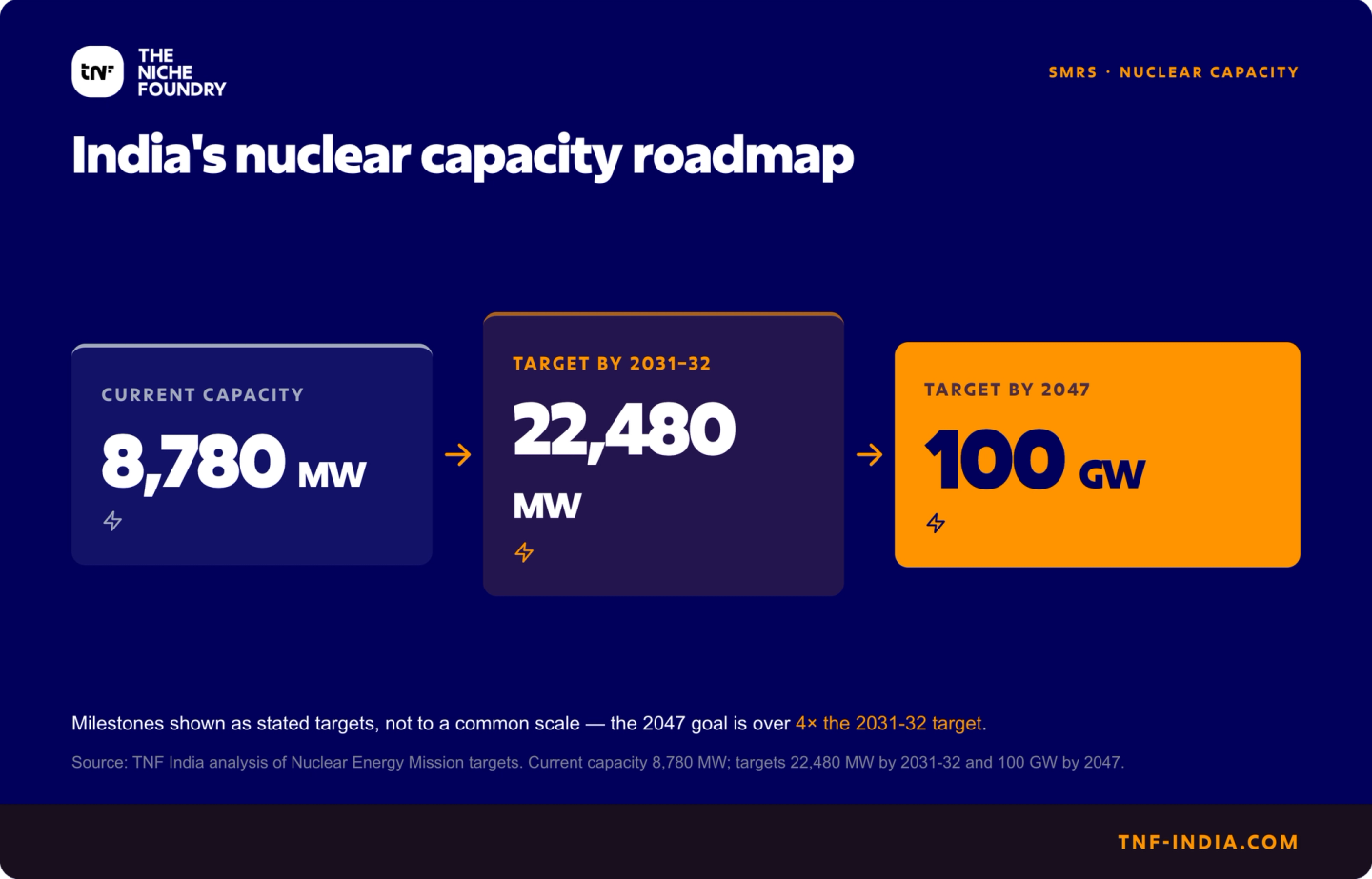
Source: Nuclear Energy Mission.
SMRs also deliver reliable repeatability, safety-by-design, shortened construction cycles, and integration with modern energy systems. India's aim is to develop and deploy at least five indigenous SMRs by 2033 through private participation and public-private collaboration. This can plug structural gaps in firm power, grid inertia, and industrial heat supply.
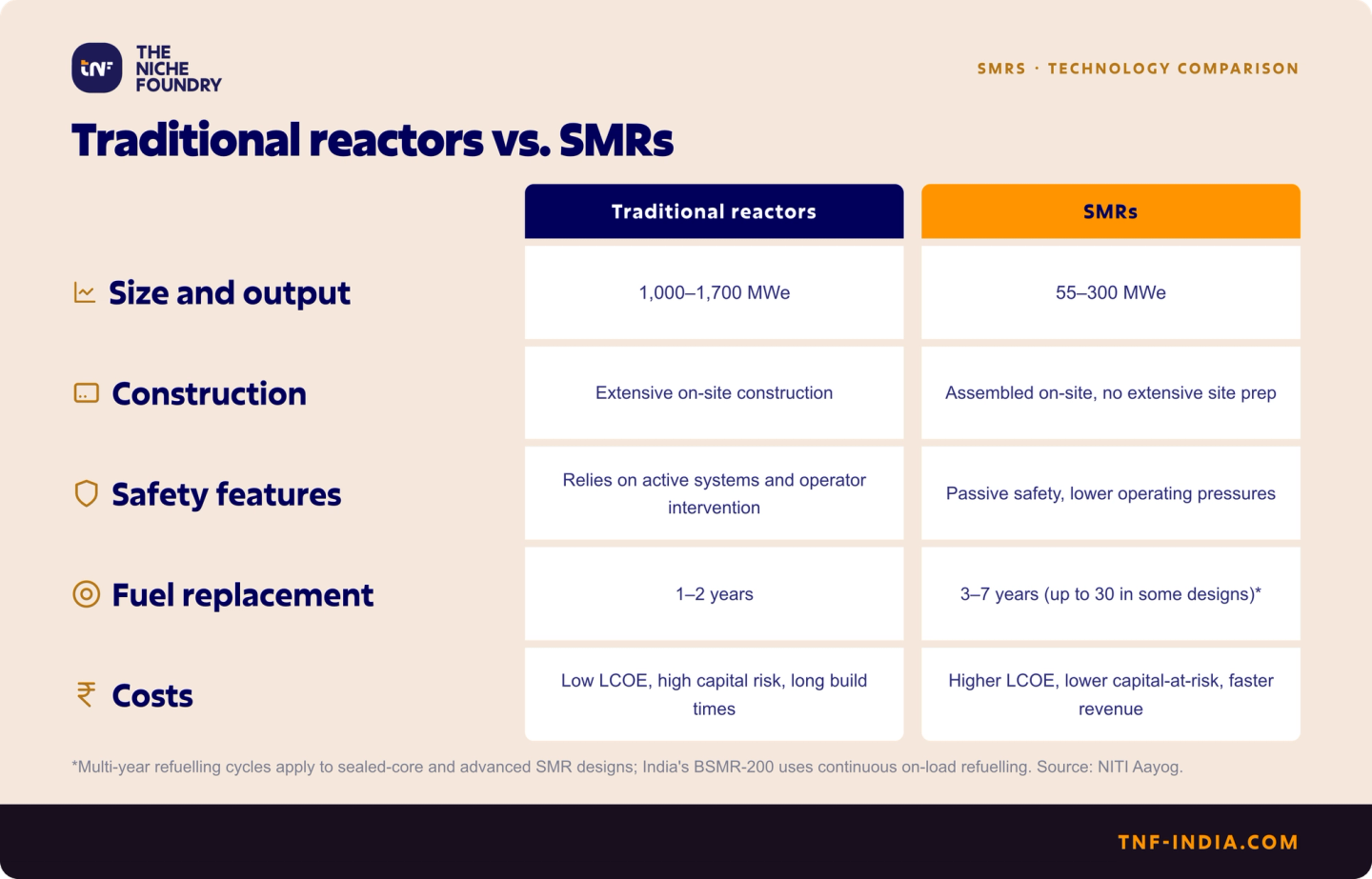
SMRs differ from conventional nuclear plants in ways that matter for deployment: smaller footprint, passive safety, and modular construction make them more adaptable to India's energy landscape than large-format reactors. The harder question is execution. Will existing SMR designs mature and be safe enough to be a pragmatic choice for the country's power generation needs?
Currently, India operates 20 pressurised heavy water reactors (PHWRs) clustered across 6 locations in the country. The tried and tested technology behind the PHWRs will help build compact, modular BSMR-200 (200 MWe) and SMR-55 (55 MWe) reactors with reduced engineering risks. SMRs can transform the power generation realities in India today, given their unique advantages like technology readiness and operational experience with multiple PHWR units.
Bhabha Atomic Research Centre (BARC) and Nuclear Power Corporation of India Limited (NPCIL) are developing the BSRs, with a design philosophy that prioritises repeatability, modular QA, and predictable licensing. These modular reactors can be assembled on site, with assured quality and short project timelines. The lead units of the BSMR-200 and SMR-55 are proposed for the Tarapur Atomic Power Station site in Maharashtra; the high-temperature gas-cooled reactor is planned at BARC's Visakhapatnam facility in Andhra Pradesh.
SMRs are designed with advanced safety features like passive safety protocols that require no electrical power or human intervention, to eliminate safety concerns and mitigate risk. This makes them resilient and lowers the probability of major accidents and mishaps. They also have compact footprints and relatively lower output when compared to large reactors. Their smaller exclusion zones permit siting adjacent to industrial clusters or urban demand centres.
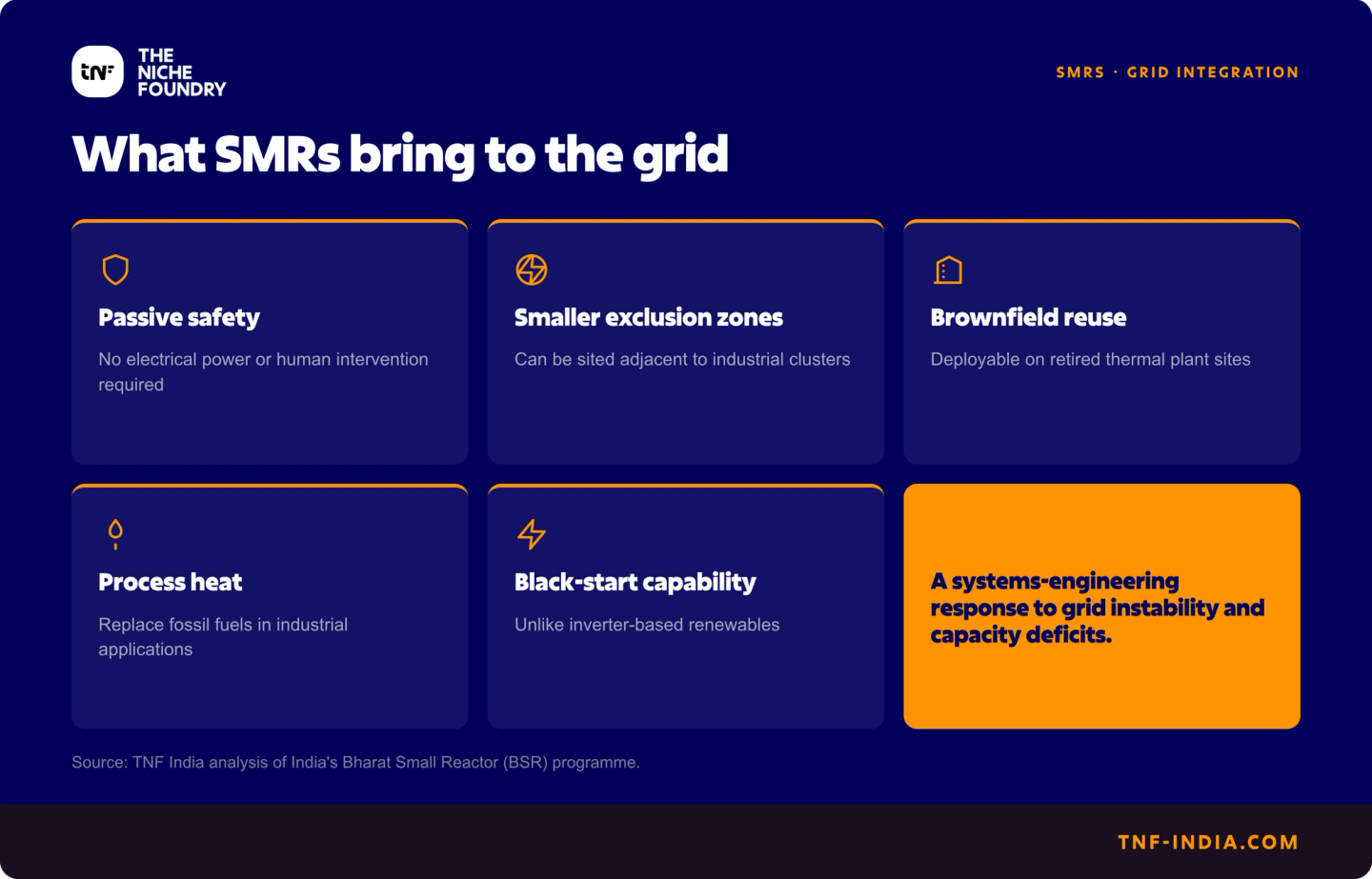
Source: TNF India analysis of the Bharat Small Reactor programme.
Their modular design enables serial production, reduces schedule risk, and capital costs. Such factory-controlled fabrication significantly reduces welding defects, rework rates, and construction variability, all of which are known contributors to nuclear project delays.
As the aerospace and shipbuilding sectors have demonstrated already, modularisation helps tighten manufacturing tolerances, traceability, and improve inspection outcomes. The BSR initiative opens the door to innovation across materials, reactor design, modular QA, digital instrumentation and control. The SMRs will be built using digital twins to fully simulate them across design, manufacturing and operations. The plans include systems integration as well as lifecycle safety engineering.
SMRs offer the additional advantage of scaling, with more units being added incrementally, based on demand. They can also be repurposed on brownfield sites, like retired thermal power plants. Shorter construction times accelerate deployment timelines. Costs reduce with the reuse of land, cooling infrastructure, and grid interconnections.
SMRs can be installed even in remote areas, to improve grid resilience and ensure consistent, clean power generation without a need for long-distance transmission lines. As a by-product, they offer high-temperature steam for industries, replacing the use of fossil fuels. Co-locating SMRs with renewables creates hybrid energy systems with improved capacity utilisation.
Recent regulatory changes have created a highly conducive environment for private investment as the Sustainable Harnessing and Advancement of Nuclear Energy for Transforming India (SHANTI) Act, 2025 repeals the norms laid down by the Atomic Energy Act 1962, and the Civil Liability for Nuclear Damage Act, 2010.
The SHANTI Act breaks the state monopoly on nuclear power. Private companies can now build, own, operate, and decommission plants, bringing the engineering capacity and manufacturing scale that the public sector has not been able to deliver at pace.
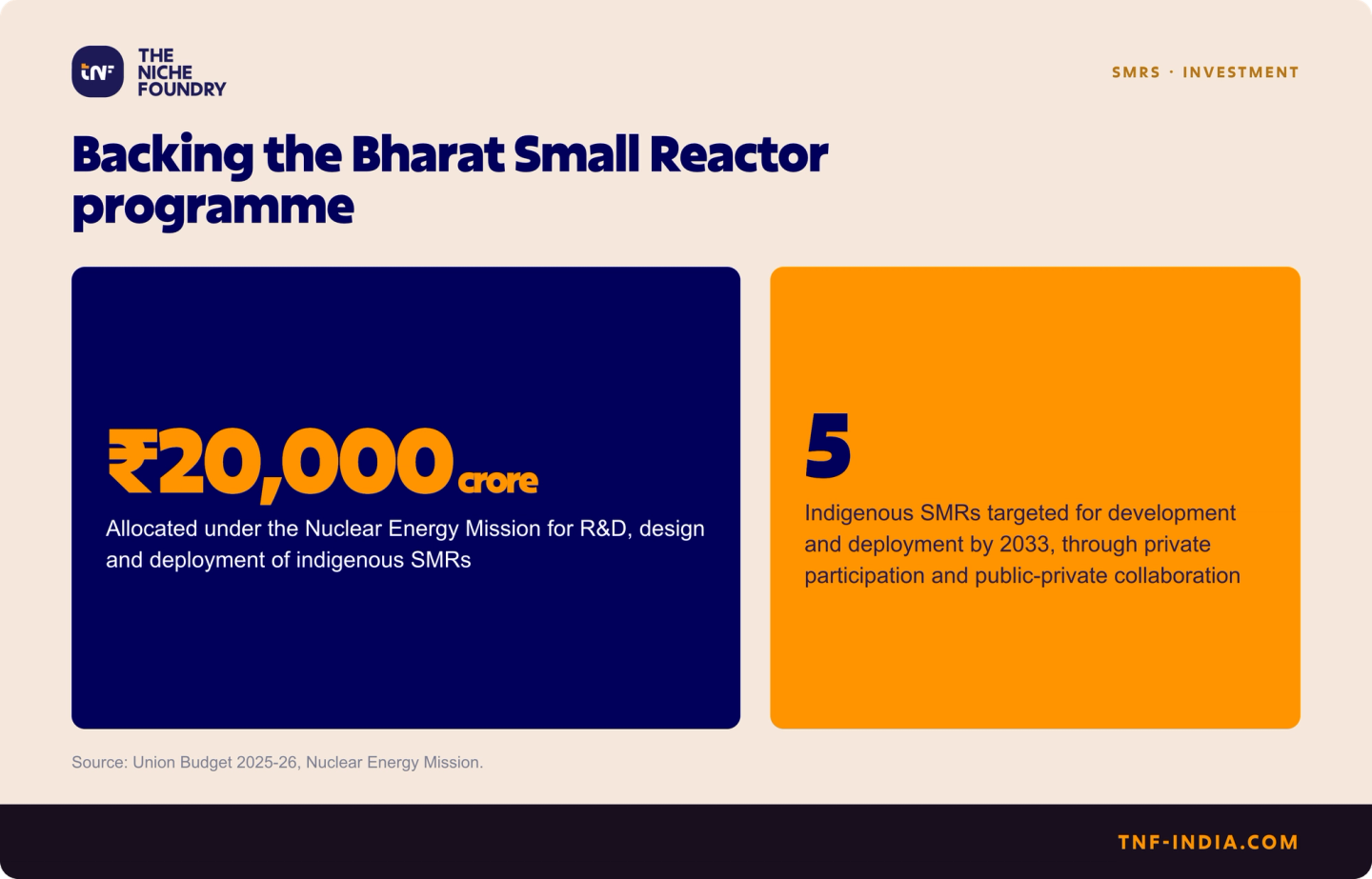
Along with enabling private sector participation, the Union budget 2025-26 allocated ₹20,000 crore to the Nuclear Energy Mission focused on SMR R&D and deployment. NPCIL has moved quickly. It has already called for proposals to build captive BSR-powered plants, targeting industries such as steel, aluminium, chemicals where low-carbon baseload is an operational necessity, not a preference.
Infrastructure is just one part of the equation. To meet its targets for SMR deployment, India needs a specialised workforce that can support the strategy every step of the way. This includes everything from SMR design to serial production and operation, while ensuring regulatory compliance, safety, and maintenance. Advanced skills in areas across design, digital tools, safety analysis and quality assurance will be critical.
So far, nuclear engineering skills were limited to roles with state-run organisations like BARC, which is leading the development of two BSR models. Training a nuclear engineer takes 10–15 years. India cannot afford to start late.
Demand for nuclear engineers, construction engineers, procurement/safety and quality control professionals will start rising in the private sector. There will be roles open in grid management, site integration, and innovation capabilities in the development of passive safety features in SMRs along with engineers who can manage high temperature gas-cooled reactors, heat exchangers and the manufacturing of nuclear-grade steel. An equally critical need for regulatory reviewers, inspectors, and safety analysts will create a bottleneck in licensing timelines.
Reactors can be sanctioned in months. Engineers take a decade to train. This is where India's SMR ambitions are most at risk.
Recent milestones such as the 500 MWe Prototype Fast Breeder Reactor attaining first criticality in April 2026 demonstrate India's growing capacity to scale complex nuclear operations.
Developers: Standardise and scale pre-approved design templates to compress licensing timelines. Treat SMRs as repeatable industrial products, not bespoke infrastructure.
Financing: Shift from project-based financing to fleet-based models to distribute risk across a standardised reactor portfolio. Introduce sovereign-backed risk guarantees to attract private capital. Align tariff structures to reflect dispatchable value, not just LCOE.
Policymakers: Communicate safety architecture transparently. Prioritise brownfield deployment. Establish standardised compensation frameworks for local communities.
Academicians: Create specialised nuclear engineering programmes in partnership with industry. Build cross-disciplinary talent pipelines across design, safety, and digital systems. Train regulatory and inspection capacity in parallel, not as an afterthought.
Operators: Co-locate SMRs with industrial clusters for captive baseload demand. Combine SMRs with renewables and storage to create hybrid systems. Use SMRs for process heat and hydrogen production, not just electricity.
Disclaimer: Content provided by TNF India is for informational purposes only. While we aim to provide accurate data and strategic insights, information is subject to rapid market and technological shifts. This content should not replace independent due diligence or professional consultation. TNF India bears no responsibility for any actions taken, or financial losses incurred, in reliance on this material.
What an owner should receive at handover, and what actually arrives.