Tuesday, 13 October 2026
To withstand future supply disruptions, India must close its strategic reserve deficit and embed maritime route risks directly into long-term procurement contracts.
To withstand future supply disruptions, India must close its strategic reserve deficit and embed maritime route risks directly into long-term procurement contracts.
 Lalita Subrahmanyam








In March 2026, when the Israel-Iran conflict spilled into the Strait of Hormuz, India found out exactly what its energy security rests on. The strategic reserves stood between the country and a genuine supply shock, but would not be sufficient for months of disruption. India had spent the previous decade doing many of the right things: adding suppliers, cutting import costs, building out renewables. None of it changed how little runway the country had once ships stopped moving through the strait.
India has since diversified its supply base to 40 countries, up from 27, though breadth of suppliers doesn't equal control over how that oil moves. Diversifying suppliers alone won't be enough to meet demand if the next disruption hits without adequate reserves and route control alongside it.
The constraint is no longer cost. It is continuity and access.
Control over how that oil physically reaches India has not kept pace with supplier diversification. India's energy security framework needs to reduce this exposure and gain control over the critical nodes that move supply, such as shipping lanes, pipelines and storage terminals. Given its import dependency, India also needs to ensure control over pricing mechanisms, insurance and strategic storage systems.
Given the risks, India needs to maintain the requisite levels of SPR, treating it as a strategic buffer and a tool for geopolitical risk arbitrage, not a cushion of last resort. The reserves help manage demand or enable monetisation depending on the risk scenario. True resilience will require control over long-term options, including SPRs and demand substitution.
Price shocks can be hedged. Supply shocks need planning and strategy.
A lot has been said already about the energy security risk. India imports nearly 88% of its crude oil and roughly 2.5 million barrels a day pass through the Strait of Hormuz. With insufficient reserves, India faces exposure to price hikes, higher freight costs, and war-risk premiums. The rerouting push covered above has moved a majority of crude onto non-Hormuz routes, and India also lifted domestic LPG production in March 2026, after refiners were ordered to divert more output to the LPG pool during the crisis.
India needs to approach its energy security framework as a system design problem, not a procurement function.
Import diversification helps, but does not constitute a framework. India's policy briefs and energy-security strategy documents outline a five-pillar framework: fossil-fuel resilience, renewables integration, climate-adaptive planning, inflation management, and clean-energy acceleration.
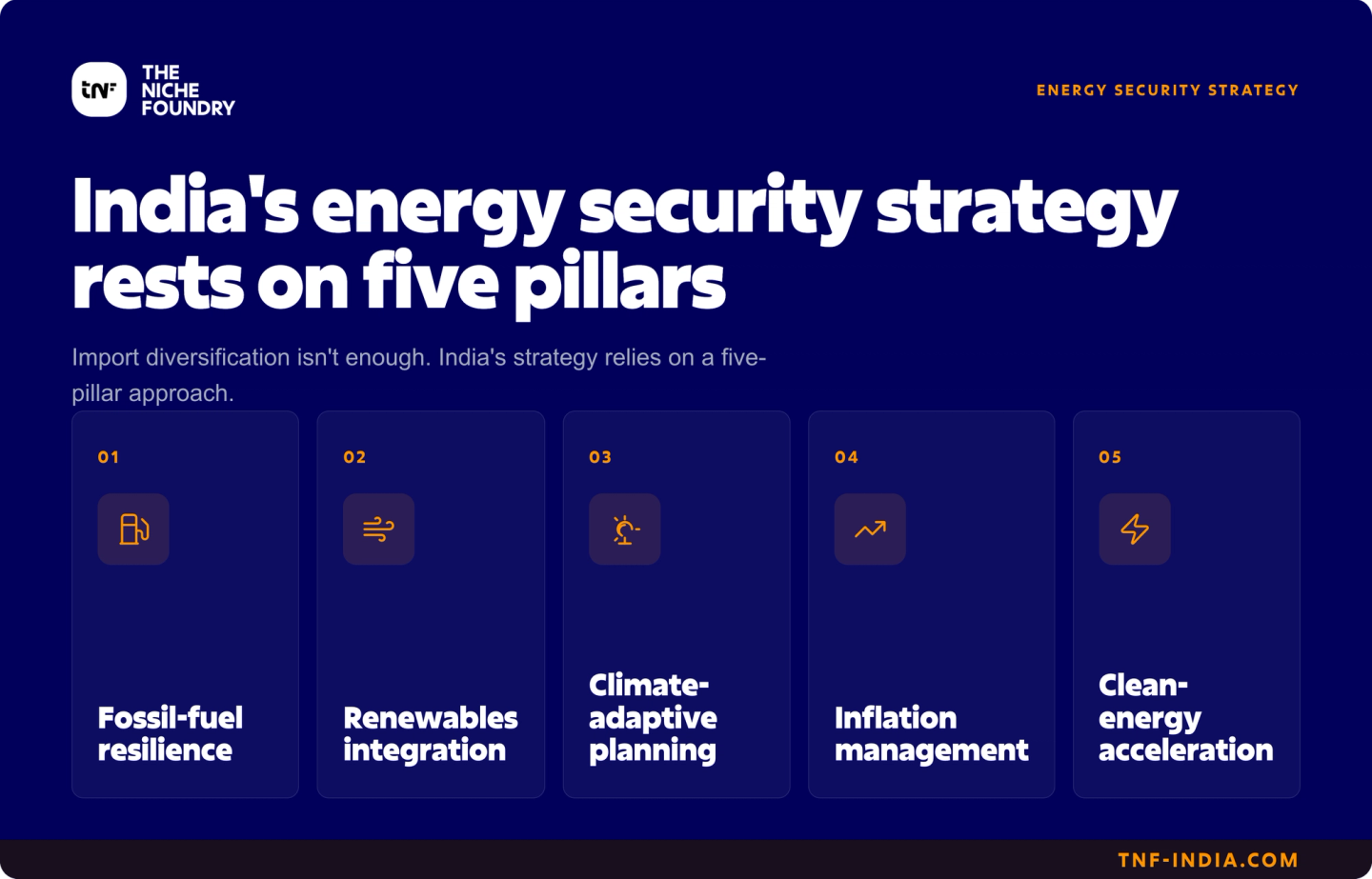
All of these must turn into operational levers. In a quantity-shock scenario, standard macro modelling suggests India's GDP, current-account balance, and inflation would all come under pressure, given its roughly 9-10-day SPR cover and high import dependency. Each crude oil spike is a real economic burden, not a hypothetical one.
India must embed risk metrics into its procurement plan and assign a risk-adjusted cost to each barrel. India needs a clear risk-capital allocation model that prices its full annual import exposure through risk-weighted procurement and long-term contracts.
It needs to transform its SPR into a price-arbitrage and macro-stabilisation lever with a strategic release mechanism. Simultaneously, it must secure maritime control by diversifying routes, building domestic tanker fleets, and managing freight and insurance costs directly.
India is putting in practical efforts to reduce concentration risk in the Gulf-centric basket. But imports from Africa and Latin America complicate the logistics and keep costs higher. To be considered truly diverse, these volumes need to be underpinned by long-term agreements, backed by investment in terminals and refining infrastructure that let India switch quickly if Hormuz-linked flows dry up.
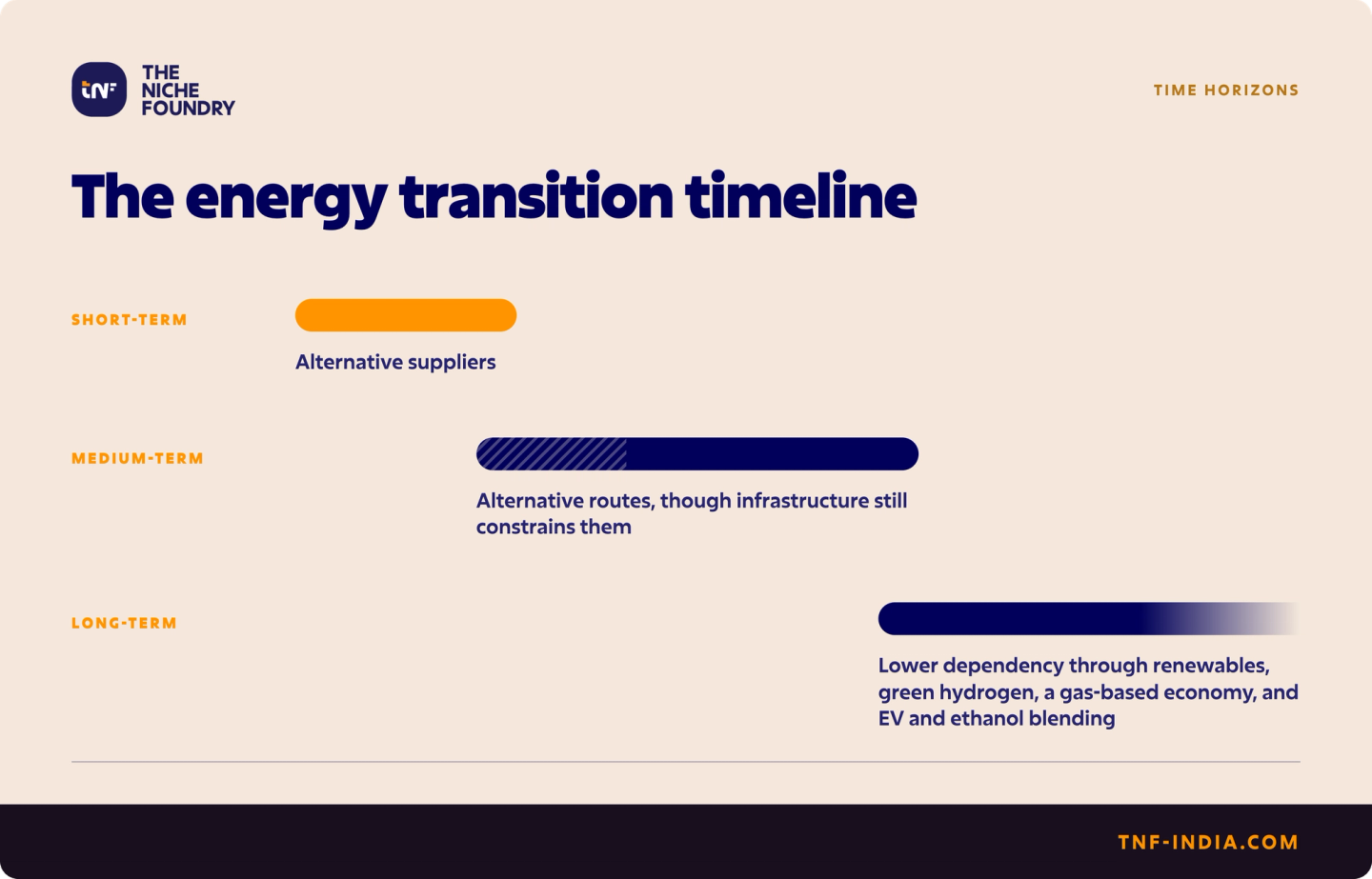
Renewables and biofuels offer a hedge, however asymmetric, that takes the pressure off India's fossil fuel imports. They add an energy buffer, support ESG compliance, and lock in long-term cost stability alongside hedging core risk. But these moves do not operate on the same timescale.
India's execution gap lies primarily in its SPR deficit, with SPR expansion progressing very slowly relative to demand growth. The expansion of India's SPRs under Phase 2 at Chandikhol (Odisha) and Padur (Karnataka) was approved in 2021; construction at Chandikhol has only recently restarted after land-acquisition delays, and Padur's expansion is still pending.
Energy transition is not just a climate policy. It is also a supply security strategy. The gap lies in integration. Diversification without infrastructure, storage, and route control remains incomplete, and the strategic storage deficit remains the biggest structural vulnerability, given India's demand of roughly 5.5 million barrels a day.
India is focused on energy security and has plans in place to increase exploration, diversification, and pipeline expansion, but execution tells a different story. Deep-sea exploration is projected by the government to reduce import dependency over the long term, though timelines remain unconfirmed. More Indian households depend on LPG, which is roughly 60% imported, than on piped natural gas (PNG), which draws more heavily on domestic gas grids. Expansion of gas pipeline connections to homes is progressing, but not at the scale needed to meaningfully shift that LPG-PNG balance.
To build a resilient energy strategy, India must execute four core priorities: scale strategic reserves to match consumption growth, derisk procurement routes, build domestic shipping capacity to reduce reliance on global carriers, and curb overall demand through aggressive electrification and efficiency. Without this shift, policy will remain reactive to crises rather than resilient to them.
Strategists: Reassess supply exposure against actual operational realities. Embed maritime route risk directly into core procurement models rather than treating it as an afterthought.
Policymakers: Fast-track SPR expansions. Mobilise private capital by opening strategic storage and logistics to commercial participation.
Energy companies: Factor freight volatility and insurance underwriting into every long-term sourcing contract, not just crude spot prices. Expand physical storage footprints in tandem with supplier lists.
Industrial consumers: Move from spot-market exposure to long-term hedged contracts. Frame energy efficiency investments as balance-sheet insurance against price spikes, not just routine cost savings.
Disclaimer: Content provided by TNF India is for informational purposes only. While we aim to provide accurate data and strategic insights, information is subject to rapid market and technological shifts. This content should not replace independent due diligence or professional consultation. TNF India bears no responsibility for any actions taken, or financial losses incurred, in reliance on this material.
What an owner should receive at handover, and what actually arrives.